Why does L.A. need its own summer classical music festival? For answers, look 6,000 miles away
Mark Swed
Read on the LA Times website >>
Download PDF >>
A tale of two exalted European city festivals begins with surprising signifiers. Conspicuously tacked on a press office bulletin board at the tony Salzburg Festival is a large photo of John Cage. The leading 20th century anti-establishment American artist is — at least in this small Salzburg dominion through which artists, writers and administrators regularly pass — a bastion of the classical music establishment.
At that other prestigious address for classical music in summertime, Lucerne, Switzerland, posters and program books are centered with the words PRIMA DONNA in large type, the I being a graphic of a conductor’s baton extending from the manicured red nail of a lady’s right hand, which is encircled by bees. This year’s theme of the Lucerne festival is the empowerment of women in classical music, particularly as composers and conductors.
Outside observers have found such queen bee business a wee bit condescending, but given that parts of Switzerland gave women the vote only in the 1970s, this is a statement. So too is the fact that the artistic director designate of the Salzburg Festival is Austrian pianist Markus Hinterhäuser, a modern music specialist known for his penetrating recordings of John Cage’s New York School.
Social progress can seem slow in this part of the world. Tradition and history weigh heavily on Switzerland and particularly Austria, where you occasionally encounter opera goers in lederhosen.
Standard repertory and standard stars prevail as they always have in both places. Audiences remain well-heeled. As always, the festivals cater to the classical music business; it can be as easy to run into an orchestra manager or artist’s representative in Salzburg or Lucerne as it is a movie producer in Cannes.
Still something startling is in the air. Lucerne celebrated its 75th anniversary in 2013 with the theme “Viva la Revolución” and festival honchos showed up for a gala event wearing Che garb. Salzburg has yet to announce next year’s program, Hinterhäuser’s first season, but Peter Sellars has said that he will be back at the festival for the first time in almost two decades.
Salzburg and Lucerne are special places. As destination festivals, they have lost none of their importance in the Internet age, however much our expectation is that anything that matters is immediately and effortlessly available.
Indeed the website medici.tv has a smattering of this year’s offerings thus far, including a new production of Gounod’s “Faust” in Salzburg and Riccardo Chailly’s compelling performance of Mahler’s Eighth Symphony with the Lucerne Festival Orchestra. As I write, I am listening on the BBC Radio 3 website to a London Proms broadcast of Mirga Grazinyte-Tyla conducting her first program as music director as the City of Birmingham Symphony Orchestra, and with a little imagination I can feel the excitement in the Royal Albert Hall.
But vicarious reality is really equivocal reality. I’m not there, I’m at my keyboard, half listening, fooling myself while allowing Grazinyte-Tyla’s thrilling Tchaikovsky Fourth Symphony to help speed my typing.
A festival, on the other hand, is a concentrated excursion away from the computer and the quotidian. It needn’t always be a special destination. The Proms, the Berlin Festival, Paris Autumn and Prague Spring and other city festivals are primarily for residents. A few small, out-of-the-way American cities have small destination festivals of note — Ojai, close to home, is one. But Lincoln Center Festival in July comes closest to a big international festival of the performance arts, and it has become less ambitious and less provocative than it once was.
What about Los Angeles? As the city weighs the feasibility of its bid for the 2024 Summer Olympics, let us remember what it meant in 1984 when L.A. mounted an Olympic Arts Festival that changed the complexion of performance arts in Los Angeles. Do we have it in us to do it again by, say, reviving the biannual Los Angeles Festival, the follow-up to the Olympic Arts Festival, which lasted only until 1993 and had ambitions to put us in the league with Berlin and Paris?
First, though, it might be worth considering how Salzburg and Lucerne did it, and how what they do now reverberates around the world.
The Salzburg Festival was founded in 1920 in Mozart’s quaint hometown at the foot of the Austrian Alps to be an international outpouring of opera, concerts and theater from the leading artists of the day. The Lucerne Festival came along 18 years later in reaction to Salzburg having become far too appealing to Hitler and his SS contingent. So the adamant anti-Fascist Arturo Toscanini started a festival on the shores of Lake Lucerne at the foot of the Swiss Alps.
Both festivals enhanced their reputations after World War II with star conductors, notably Herbert von Karajan in Salzburg and Wilhelm Furtwängler in Lucerne. Recordings of concerts and operas from the festivals automatically had the stamp of quality. An air of exclusivity wafted over both places as new concert halls and opera houses were built and offerings became more lavish.
Today Lucerne, which is primarily devoted to concert music, has a budget of around $27 million, while Salzburg, which produces opera and theater as well as concerts, boasts a budget more than double that.
That kind of bankrolling (most of which is private support) can, of course, lend an air of exclusivity, which both festivals have worked hard to lessen, while becoming much more expansive. And to that end, they sponsor education projects, foster emerging artists and commission new work. In Salzburg the lasting contribution from this summer is likely to be the premiere of Thomas Adés’ opera, “The Exterminating Angel,” a work meant to challenge the very essence of status quo — shockingly so in its harsh depiction of stymied high society — which will now be done at Royal Opera in London and at the Metropolitan Opera in New York.
I was also stuck by the Salzburg debut of pianist Yuja Wang. She may be on the flashy side for the more conservative audiences, but she couldn’t have been more modestly respectful — or daring — than to step into eminent Salzburgian shoes. At a legendary 1970 song recital here, German baritone Dietrich Fischer-Dieskau and Russian pianist Sviatoslav Richter, two of the most celebrated musicians of their time, performed Brahms’ song cycle “Die Schöne Magelone.” This summer, in the gilded great hall of the Mozarteum, Wang became the steady hand that saved overwrought baritone Matthias Goerne from his excesses and helped signal a new maturity for the 29-year-old pianist.
At Lucerne, a number of worthy women conductors — Grazinyte-Tyla, to be sure, but also the likes of the American big-band jazz leader Maria Schneider and the adventurous Canadian singer-conductor Barbara Hannigan — are getting important exposure. The biggest news, though, is likely to be the contribution from Olga Neuwirth, this year’s composer in residence.
I heard a performance of her impressive recent immersive work, “Le Encantadas,” in which the audience was surrounded by instrumental groups and electronic music from loudspeakers. It is a gripping evocation of the Galapagos, inspired by Herman Melville’s voyage to the South American islands, that revealed an alluring and unsettling strangeness even one of America’s greatest writers could not capture as well.
Now back home. Arguments could be made for and against Los Angeles becoming a major festival city. The Los Angeles Philharmonic, where Grazinyte-Tyla began as a Dudamel fellow and is associate conductor, does an exceptional job promoting young talent and commissioning new work. Schneider was a featured artist five years ago at the Ojai Music Festival; Hannigan will be its music director in 2019. Not all that serves as news on the European festival circuit is necessarily news to visiting Angelenos.
Moreover, much of what was new and exciting in dance and theater at the Olympic Arts Festival, which opened with Pina Bausch, the choreographer then unknown in the U.S., is now regularly presented by the Center for Art of Performance at UCLA and REDCAT. Even so, we are a multicultural city that barely scratches the surface of consequential work created in Europe, Asia, South America and Africa. For that we need a festival.
So what would it take? First of all, money. Michael Haefliger, Lucerne’s visionary executive and artistic director, told me that if L.A. is going to present a festival it would require a large-scale, full-time operation.
Robert Fitzpatrick, the former president of CalArts who created the 1984 Olympic Arts Festival, said that civic enthusiasm is essential to doing something exceptional. “A festival,” he said over the phone from Long Island, N.Y., “has to be a moment of discovery.”
Fitzpatrick reminded me of the fights he had when he wanted to open his follow-up Los Angeles Festival in 1986 with a Canadian circus no one had ever heard of called Cirque du Soleil. They thought he had to be kidding.
For Fitzpatrick money comes once you have the civic support. Then-Mayor Tom Bradley threw the power of City Hall behind the L.A. Festival. That, Fitzpatrick said, opened doors to donors like Lew Wasserman and Barry Diller.
There is cautious talk coming from the Music Center about an ambitious summer festival, employing its underused-in-the-summer campus, Grand Park and, I would hope, a host of potential venues around downtown. But festivals must be big and bold to matter. Let the talk turn to shouting into loudspeakers at whatever volume is necessary to drown out downtown construction and penetrate the thick walls of the nearby county and city offices.

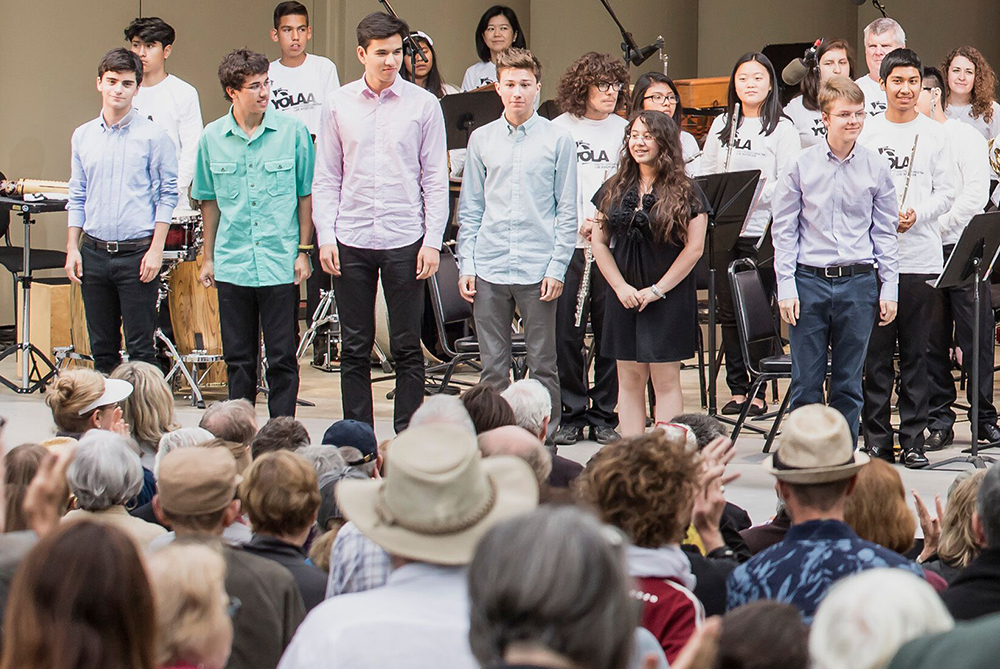
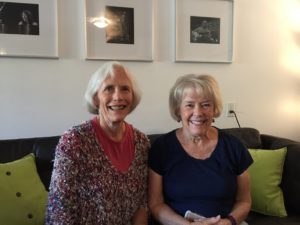 The Ojai Music Festival is pleased to announce Sandra Shapiro and Merrill Williams as new co-chairs of the BRAVO Education Committee. Both Sandra and Merrill are excited to help the program in bringing music programs to school children throughout the Ojai Valley, including Music Van, the Imagine concert, Chumash Music and Culture, Education Through Music (ETM), and the Upbeat Percussion Workshops at Continuing Care Centers.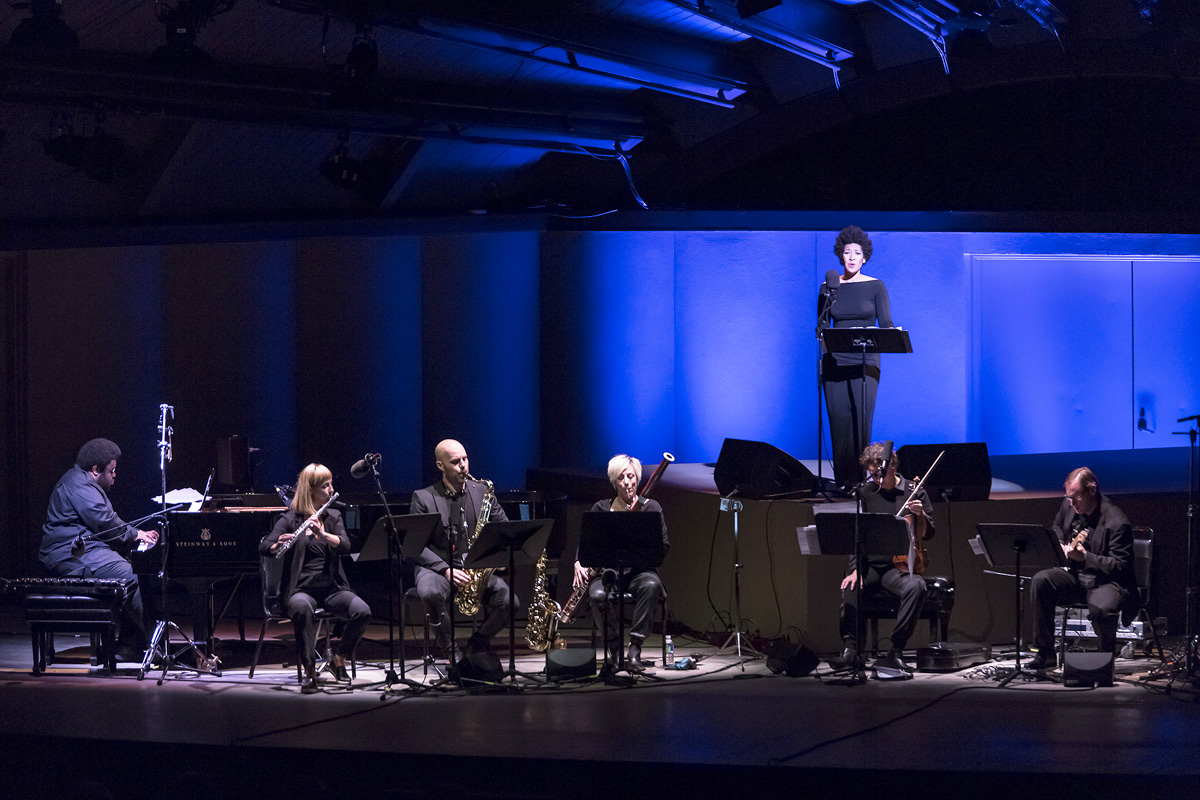

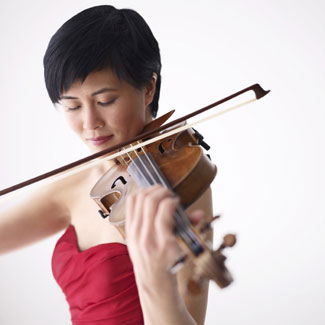
 Violinist Jennifer Koh is recognized for her intense, commanding performances, delivered with dazzling virtuosity and technical assurance. With an impassioned musical curiosity, she is forging an artistic path of her own devising, choosing works that both inspire and challenge. She is dedicated to performing the violin repertoire of all eras from traditional to contemporary, believing that the past and present form a continuum. She is also committed to exploring connections in the works she performs, searching for similarities of voice among diverse composers and associations within the works of a single composer. For her forward-thinking approach to classical music, presenting a broad and eclectic range of repertoire and fostering multidisciplinary collaborations with artists of all types and styles, Ms. Koh has been named Musical America’s 2016 Instrumentalist of the Year.
 on piano and drums.
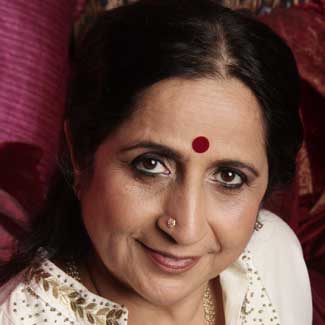
 Padma Shri Aruna Sairam, a renowned music ambassador of India, is one of the great classical music voices of India. Her style is rooted in tradition, yet continues to evolve. She belongs to the Veenai Dhanammal school of Carnatic music, known for its strict adherence to tradition and form. After her initial learning from her mother, who was a classical singer, Aruna, at the age of 10, became a disciple of the legendary T. Brinda. (T. Brinda is from the family of T. Balasaraswathi and T. Viswanathan—pioneers who brought South Indian classical music to the United States.) She was the first to introduce the Abhang, a distinctive folk music form from Western India, into a traditional Southern Indian Carnatic concert. She has also collaborated with leading musicians such as Dominique Vellard of France (classical liturgical, medieval, and Gregorian chants); Noureddine Tahiri of Morocco (Arabo-Andalusian music); Christian Bollmann of Germany (neo-classical music); Bollywood singer Shankar Mahadevan; mandolin virtuoso U.Srinivas, dancer Chandralekha; and multi-instrumentalist Ranjit Barot.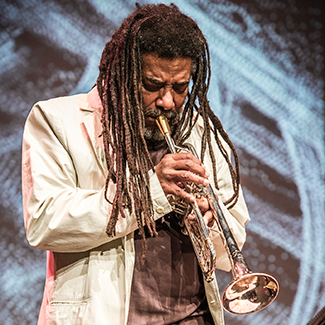
 A trumpeter and multi-instrumentalist, composer, and improviser, Ishmael Wadada Leo Smith has been active in creative contemporary music for over forty years. His systemic music language Ankhrasmation is significant in his development as an artist and educator.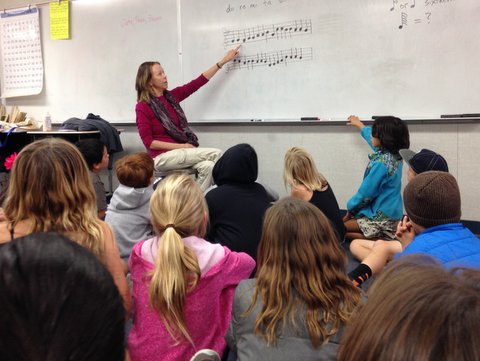


 When we create music, the brain uses many networks to process phrases, melody, rhythm, and timbre, or tone color. The brain’s auditory areas light up, but so do areas responsible for motor skills, emotions, and creativity. Music employs many sensory systems at once. We are seeing, we are hearing, we are saying, we are doing. Because of this, memory and intelligence improve.
  fragility and is primarily interested in exploring limits of perception. More specifically, he is interested in the use of silence, listening, text, and sound as equally considered elements in the compositional practice; for instance, the composer’s task is not only to consider the parameters of determined sound making (both text and instrumental), but also the parameters of how we listen, and how we may interact with and frame silence. The composer, then, seeks to create situations of possible events which the audience, performer(s), and composer all experience concurrently. Further, Luke considers the social and political disposition of a performance a very connected aspect of his work: how can one critically think about the hierarchical roles and power relations at work in a given performance, and then potentially subvert or support them. Recently inspired by David Dunn’s notations for listening and Lasse Thoresen’s spectromorphological analysis of electronic music and sound, Luke is in the beginning stages of developing a notation for silence (i.e., incidental sounds, contingency).
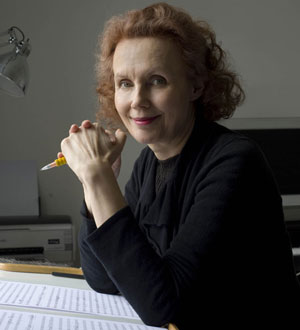 For the first time the composer
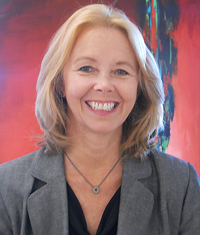 Laura writes, “What an honor to be involved with the Ojai Music Festival as the new Education Coordinator! Andy Radford has done a wonderful job of enriching the lives of the community, and I look forward to continuing his good work. Through the avenues of singing, percussion, flutes, and learning about the music of the Chumash culture, the BRAVO program acts as an important voice, bringing many enriching experiences of music to the people of the Ojai Valley and Ventura County. I’m so excited to be able to contribute! Music helps us feel a larger whole, a part of something bigger than ourselves. When beauty is created through feeling and thinking, an elevation occurs, a greater awareness and appreciation. Our world is better for it.”