Blog

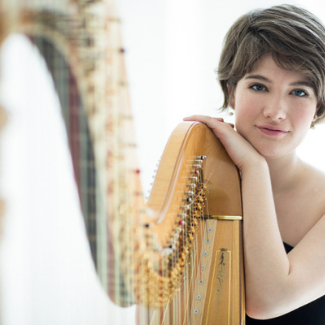
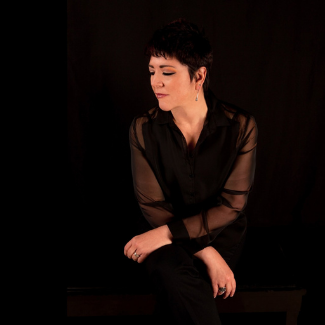
  • Emily Levin, harp

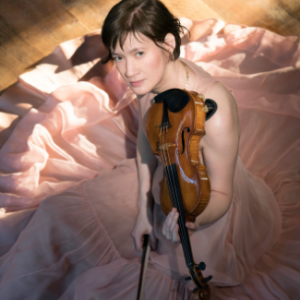
    Emily Levin, harp


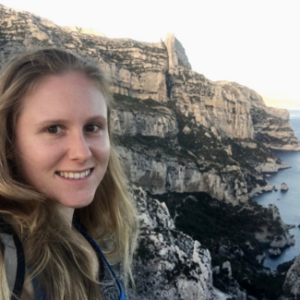
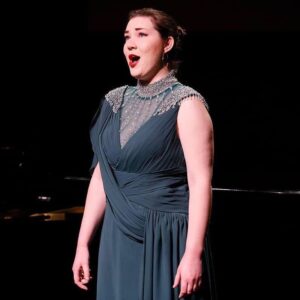
    is the Principal Harpist with the Dallas Symphony Orchestra and Bronze Medal Winner of the 9th USA International Harp Competition. Her playing has been praised for its “communicative, emotionally intense expression” (Jerusalem Post) and the Herald Times commended her “technical wizardry and artistic intuition.” As a soloist, orchestral musician, and chamber collaborator, Levin brings the harp to the forefront of a diverse musical spectrum, using her instrument to connect with all audiences.

    (more…)

  • Music For Our Time

    Music For Our Time

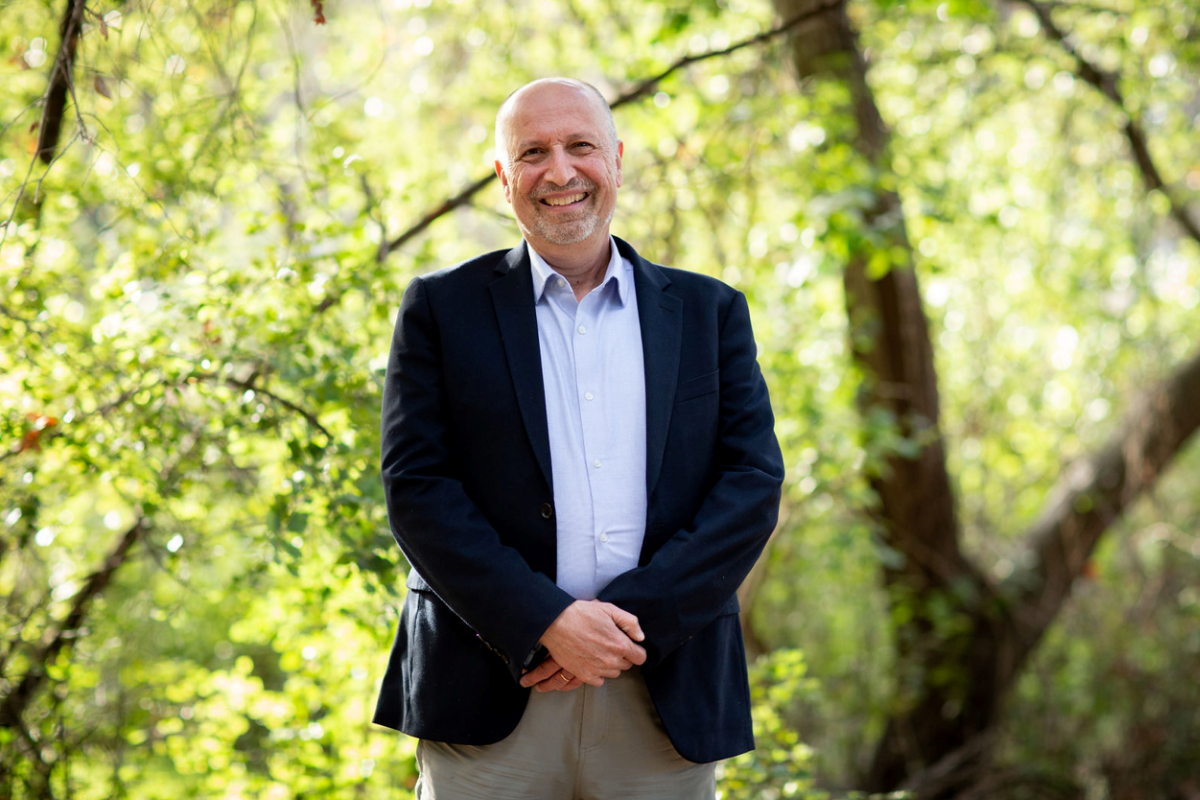
    A Message from Ara Guzelimian, Artistic & Executive Director 

    I write this on a bright November day, the air fresh with the crispness of the season. It has been a time of extraordinary events, marked a few days ago by an election of extreme division. We continue to be in the midst of an unprecedented pandemic, which has brought much loss, separation, and isolation. All of that is compounded by the racial and economic fissures made apparent by events of the past year.
     
    How do we measure this time in our innermost thoughts? Many years ago, I first met Peter Sellars at a conference in San Diego where he was giving a talk. His remarks have stuck with me, growing in importance with the passage of time. Peter said that our response to the arts is one of the few truly private experiences we have at a time of very little privacy. We encounter a book, a play, a piece of music, a work of art, a dance; we may express a public opinion and may even try to second-guess what a “correct” and “sophisticated” opinion might be. But when all is said and done, when the lights are out and our head hits the pillow, we are left alone with our experience of the art. We love it or we don’t, it speaks to us or it doesn’t, we understand it or we are left confused. But, in the end, we feel what we feel and think what we think.

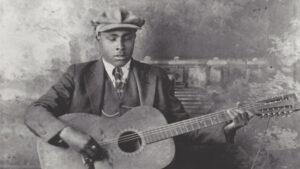
    Like so many of us, I have turned to music of every variety imaginable to keep me company in this roller-coaster time. I’ve found myself returning to a Smithsonian anthology of the blues that I’ve had for years but had overlooked more recently. There is such richness in this tradition and, as B.B. King observed, “blues is a tonic for what ails you. I could play the blues and not be blue anymore.” One of the most moving discoveries among these old recordings is this one, sung and played by Blind Willie Johnson (inset photo), that summons up a well of human expression without a single word being uttered. Here is a recording made nearly 100 years ago that reaches out across time and speaks to us with amazing currency. This is the raw power of music in its ability to express deep emotion.

    My other constant has been the music of Bach, especially in the hands of great pianists. Bach’s music is informed by his unshakable faith, an abiding humanity, as well as a sense of order and design. In working with John Adams to plan the 2021 Ojai Festival, I have been listening intently to the recent recordings by one of our artists, the Icelandic pianist Víkingur Ólafsson, a pianist as at home in Bach as he is in the music of Philip Glass. His recent Bach recording is one of exceptional beauty, and I have returned to it often to provide a grounding in this disrupted time. As Víkingur wrote, “everything is there in Johann Sebastian’s music: architectural perfection and profound emotion.” Here is the Adagio from Bach’s Concerto in D Minor, BWV 974:

    I happily anticipate Víkingur’s participation next year and am so grateful to John Adams for suggesting him as one of the first guest artists to invite. John himself has had an uncanny ability to give voice to American experience throughout his career – he is a musical chronicler of our times. In recent days, I found myself thinking about The Wound Dresser, a 1989 setting of Walt Whitman’s poem of the same name. In it, Whitman documents his experiences tending to the Civil War wounded in makeshift field hospitals. 
     
    In listening recently to The Wound Dresser, I have been so struck by the resonances with our own moment in time – the deep divisions in the country on one hand and the boundless generosity of so many health workers and caregivers in this pandemic on the other. Whitman writes “Thus in silence in dreams’ projections, / Returning, resuming, I thread my way through the hospitals, / The hurt and the wounded I pacify with soothing hand.”

    John wrote about the work, “It is a statement about human compassion that is acted out on a daily basis, quietly and unobtrusively and unselfishly and unfailingly.” Another [Whitman] poem in the same volume states its theme in other words: ‘Those who love each other shall become invincible . . . ‘”
     
    And so, we are reminded that artists are our truth-tellers and our chroniclers, their work our necessary companions through thick and thin. I am also reminded that we turn to the arts particularly in trying times. As we approach the 75th Festival in June, it is meaningful to recall that the Festival was founded in 1947, when the world was just barely emerging from World War II. The Festival’s very existence comes from an act of hope and optimism at a time of rebuilding in the face of adversity. In that spirit, we hold the promise of the next Ojai Festival as a similar act of faith. 

    When we gather together to listen to music, we assert our humanity, our belief in the arts, and in community. Thanks to each of you for creating the warm and welcoming spirit of community that defines the Festival. I am so gratified to be working with the musicians who will bring to life the 75th Festival. And I relish the promise of listening to their music in your company.


  • Look toward the Future

    Look toward the Future


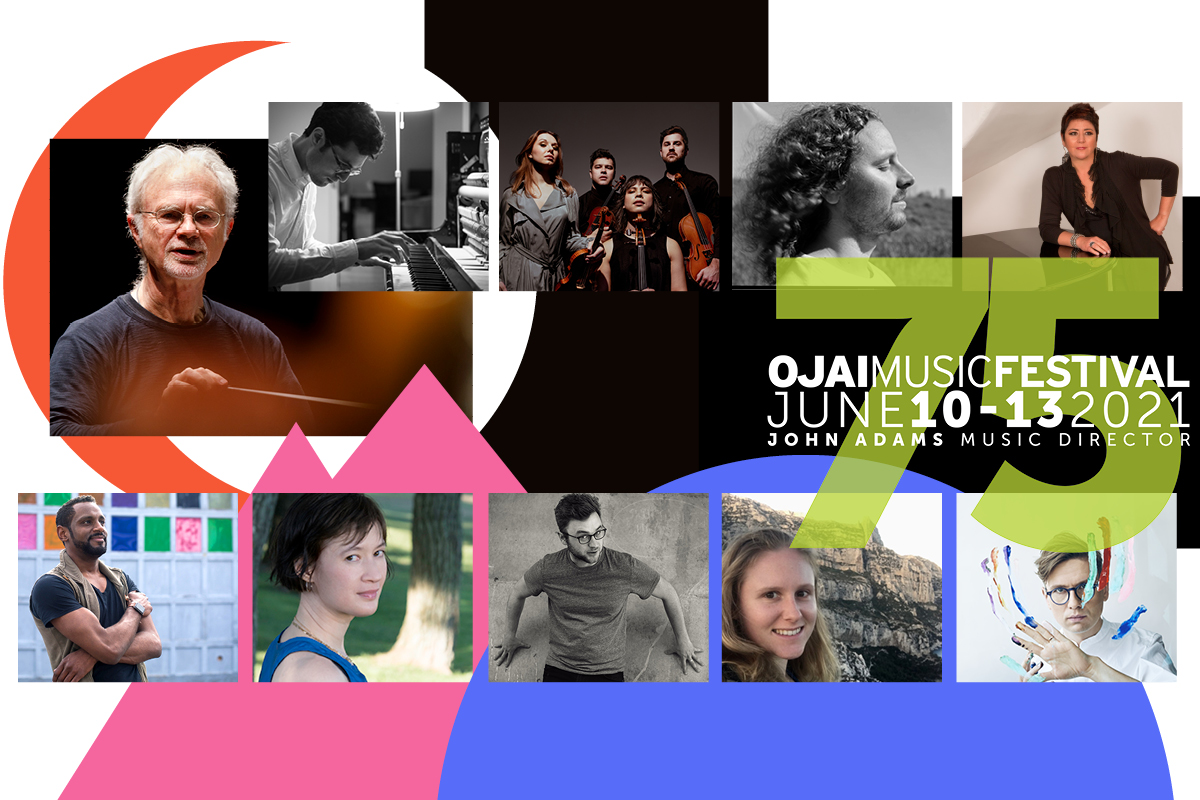
    The 75th Ojai Music Festival with Music Director John Adams June 10-13, 2021

    2021 Artists include:

    Samuel Carl Adams * Timo Andres * Attacca Quartet *
    Miranda Cuckson * Dylan Mattingly *
    Víkingur Ólafsson
    Gabriela Ortiz * Carlos Simon * Gabriella Smith 


    “As we respond to these immensely challenging times both globally and here in the US, now, more than ever, we are placing our faith in the next generation to show us the way forward. John Adams has been unwavering in his desire to focus the 75th Festival on some of today’s most vibrant and innovative composers and performers. We look forward to all that they represent – both for this treasure of a Festival and, more broadly, for our world.  They give me great hope and it is an honor to launch a new era for Ojai alongside such remarkable artists and thinkers.”  – Ara Guzelimian, Artistic & Executive Director  

    Music Director John Adams, who is both curator and conductor for this milestone Festival, focuses on composers of today whose music will be threaded throughout the Festival in June 2021. Featured composers include Samuel Carl Adams, Timo Andres, Dylan Mattingly, Gabriela Ortiz, Gabriella Smith, and Carlos Simon, many of whom will be in residence during the Festival.

    Adams conducts two concerts that will include an eclectic mix of works by Steve Reich and Mozart, alongside premieres from Carlos Simon and Samuel Carl Adams.

    John Adams shares: The Ojai Festival has always expressed a unique point of view — this combination of casual manner and extraordinary experiences that bring daring imagination and creativity. There is an openness where music is treated the way people treat contemporary art – it’s the main event and not on the side. 

    Making their Ojai debuts are violinist Miranda Cuckson (who will return with AMOC as the 2022 Music Director) performing Kaija Saariaho, Anthony Cheung, Bach, and Dai Fujikura; Icelandic pianist Víkingur Ólafsson in a solo recital of works by Philip Glass, Bach, John Adams, Debussy, and Rameau; and Grammy-Award winning Attacca Quartet in a concert of music by Caroline Shaw, Jessie Montgomery, Paul Wiancko, and Gabriella Smith.

    Ojai welcomes the return of Timo Andres, an Ojai alum from the 2014 Festival, performing I Still Play, a series of ten works by such composers as Laurie Anderson, Louis Andriessen, Donnacha Dennehy, Nico Muhly, and Philip Glass. This Ojai recital will mark the first live public performance of the cycle, which was commissioned as a tribute to legendary Nonesuch Records President Bob Hurwitz. 

    The Festival will honor long-standing ties with the Los Angeles Philharmonic, with a concert by the LA Phil New Music Group featuring the world premiere of a co-commissioned work by Dylan Mattingly, as well as music by Gabriela Ortiz and John Adams.

    To celebrate the Festival’s wide-reaching BRAVO education program, Ojai school children will perform alongside Festival artists in a free community concert. In addition, featured artists and composers will hold free workshops for Ojai public school children leading up to the Festival.

    The 2021 Festival resident chamber orchestra will consist of freelance artists from Southern California and from around the US, many of whom populate the nation’s gifted new-music ensembles.  Ojai is pleased to draw from this incredibly talented group of US-based independent musicians, especially at this time when so many in this community are experiencing significant professional disruption caused by the pandemic.

    A Homecoming Celebration
     We can’t wait to welcome all of you back to Ojai for the 75th Festival next June! The Festival represents an ideal of adventurous, open-minded and open-hearted programming in the most beautiful and welcoming of settings, with audiences and artists to match its aspirations. The Festival, in so many ways, marks a homecoming for all of us.  As John and Ara embrace their own returns to Ojai, our reunion with all of you at the upcoming Festival marks the beginning of new era for our beloved Festival.   

    Stay Tuned and Tune In 
    We will continue to share updates of the 2021 Festival in the coming months, with additional artists and programs yet to be announced.  In the meantime, join us for ongoing virtual content with our next Ojai Talks on Wednesday, October 28 featuring 2021 Festival Resident Composer Gabriela Ortiz, hosted by Festival Producer Fiona Digney.   

    Click here to RSVP  

    ******

    Covid-19 Planning 
    The 2021 Ojai Music Festival will work closely with public health officials to adhere to the highest standards of health and safety for our entire onsite family, including our patrons, artists, staff, and community partners.  Details regarding related considerations and protocols will be announced in the coming months.  Please do not hesitate to reach out to Gina Gutierrez if you have questions.   


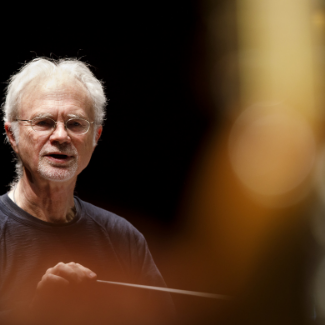
  • John Adams, 2021 Music Director

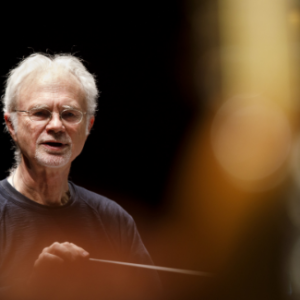
    John Adams, 2021 Music Director

    Composer, conductor, and creative thinker – John Adams occupies a unique position in the world of music. His works stand out among contemporary classical compositions for their depth of expression, brilliance of sound, and the profoundly humanist nature of their themes; his stage compositions, many in collaboration with director Peter Sellars, have transformed the genre of contemporary music theatre. Spanning more than three decades, works such as HarmonielehreShaker LoopsEl Niño and Nixon in China are among the most performed of all contemporary classical music. 

    (more…)

  • Samuel Adams, composer

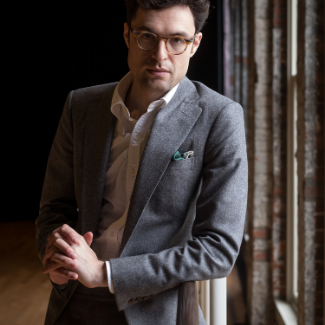
    Samuel Adams, composer

    Recently named a Guggenheim Fellow, Samuel Adams (b. 1985, San Francisco, CA) is a composer of acoustic and electroacoustic music. His work has been hailed as “mesmerizing” and “music of a composer with a personal voice and keen imagination” by The New York Times, “canny and assured” by The Chicago Tribune and “wondrously alluring” by The San Francisco Chronicle.

    (more…)

  • Timo Andres, composer & piano

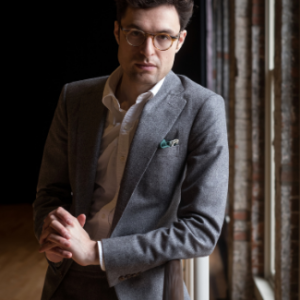
    Timo Andres, composer & piano

    Timo Andres (b. 1985, Palo Alto, CA) is a composer and pianist who grew up in rural Connecticut and lives in Brooklyn, NY. A Nonesuch Records artist, his album of orchestral works, Home Stretch, has been hailed for its “playful intelligence and individuality,” (The Guardian) and of his 2010 debut album for two pianos Shy and Mighty (performed by himself and duo partner David Kaplan), Alex Ross wrote in The New Yorker that “it achieves an unhurried grandeur that has rarely been felt in American music since John Adams came on the scene… more mighty than shy, [Andres] sounds like himself.”

    (more…)

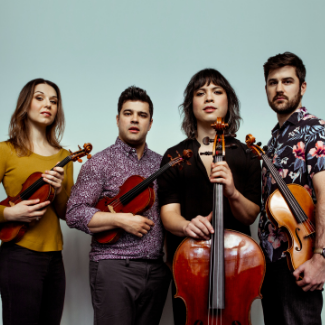
  • Attacca Quartet

    Attacca Quartet

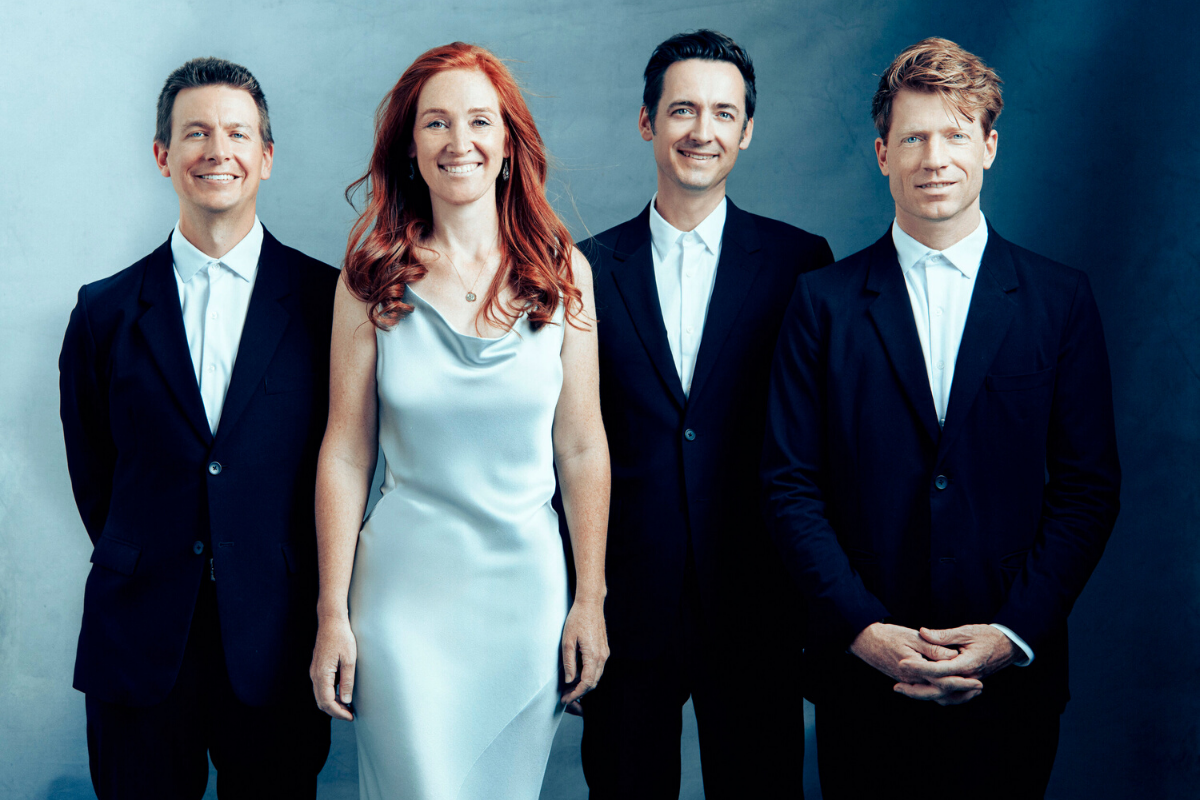
    Grammy award-winning Attacca Quartet, as described by The Nation, “lives in the present aesthetically, without rejecting the virtues of the musical past”, and it is this dexterity to glide between the music of the 18th through to 21st century living composer’s repertoire that has placed them as one of the most versatile and outstanding ensembles of the moment – a quartet for modern times. 

    (more…)

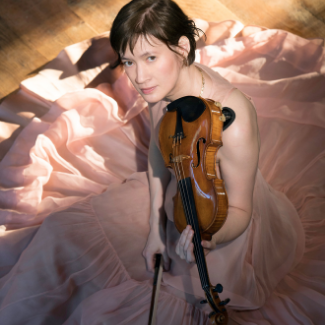
  • Miranda Cuckson, violin

    Miranda Cuckson, violin

    American violinist and violist Miranda Cuckson delights audiences with her expressive playing of a large range of music, from the newest creations to music of older eras. She has in recent years become one of the most acclaimed and dedicated champions of contemporary music, moving new music more into the center of classical music life. She is passionate about the creative and communicative role of the performer/interpreter in the artistic process. Downbeat magazine said “violinist Miranda Cuckson reaffirms her standing as one of the most sensitive and electric interpreters of new music.” Her recording of Luigi Nono’s “La lontananza nostalgica utopica futura” for violin and electronics with Christopher Burns (Urlicht AV) was named a Best Recording of 2012 by the New York Times

    (more…)

  • 2021 First Glance

    2021 First Glance


    Welcome to the dog days of summer. For a long time, I thought the phrase referred to the hottest days of August, when even the liveliest dog would droop to a long nap in the shade of the tree. I then learned the much more inspired origin of the phrase. August is when Sirius, the brightest star of Canis Major, the ‘dog constellation,’ appears on the southeast horizon just before sunrise. Sirius is indeed the brightest star in our skies, twice as large as the sun and 25 times its brightness.

    I love the notion that the brightest star visible to us rises at the darkest hour of the waning night. There is comfort in contemplating that beauty of our natural world while we droop with the heat of the summer and the tensions of our troubled world. That bright light is there for us to see, if we know where to look.

    It is with that spirit of hope and with the anticipation of better times ahead that I write today with some glimpses of the Ojai Festival to come in June 2021, when we eagerly anticipate gathering again in the beauty of Libbey Park and with the joy of each other’s company.

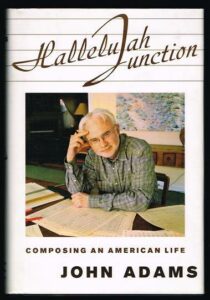
    John Adams was foremost in my mind when I began to think about the 75th Ojai Festival. John is such a distinctly American voice in classical music, capturing the spirit of our time, much as Aaron Copland did two generations ago. He was born a New England Yankee and has cherished memories of being taken by his parents to hear Duke Ellington and his Orchestra at the dance pavilion on the shores of Lake Winnipesaukee in New Hampshire. His memoir Hallelujah Junction is one of the most engaging and evocative autobiographies to be published in recent years and shows him to be a gifted writer as well as composer – I highly recommend it as hugely rewarding reading. You can check out the book here – this is a website that benefits independent booksellers across the country!

    But John long ago made that mythical cross-country trip in a beat-up car to become the quintessential California composer, having made the San Francisco Bay Area his home for nearly fifty years now. In planning our programs for 2021, he has been characteristically resistant to making the festival have a focus on his music but I have prevailed for us to have representation of his music. Here is a recent piece that will be new to most of us, a lovely, personal piano piece called I Still Play, as recorded by 2014 Ojai Festival Music Director Jeremy Denk:


    John has made it very clear that he wants to feature the work of a new generation of composers and performers to make this a decidedly forward-facing festival.  The composers are all young Americans, representing the diversity of voices, styles, cultures and traditions that comes naturally to a new generation. Among them, we will welcome Gabriella Smith, who was mentored by John. Her trailblazing career has led her music to be performed by the Los Angeles Philharmonic, Roomful of Teeth, Eighth Blackbird, Bang on a Can All-Stars, among others. She is a true California spirit, as passionate about the landscape and the environment as she is about her musical life. Read more about Gabriella on our website.

    At the beginning of my planning conversations with John, he had just returned from an extended European tour where he had collaborated multiple times with the young Icelandic pianist Víkingur Ólafsson  – he spoke about Vikingur in the most glowing terms and expressed his great wish to bring him to Ojai. I was delighted with the suggestion and we invited Vikingur, who immediately accepted. He has been widely praised for a series of imaginatively programmed recordings focusing on Philip Glass, Bach and a recent pairing of music by Debussy and Rameau, French composers 300 years apart.

    By way of introduction, I’m delighted to bring to you two recent videos. The first is Debussy’s well-known Prelude titled in English, The Girl with the Flaxen Hair.

    And, in a music video filmed at the Harpa concert hall in Reykjavik, music by Philip Glass.

    This gifted young artist has drawn the attention of the New Yorker’s insightful music critic, Alex Ross, who wrote recently about him in this article.

    And what about the resident orchestra, you ask? Again, the answer represents a homecoming. We are selecting a handpicked, all-star ensemble of some of the finest musicians around, who populate the new music groups and other ensembles up and down the California coast. This time of enforced isolation and suspended musical life has caused extraordinary hardship for so many artists, with freelance musicians among the most affected by the loss of work and income. We are delighted to celebrate the extraordinary talent in our midst by welcoming these brilliant independent artists to center stage. We are coming home.

    In one of my meetings with the Ojai team, I was delighted to become better acquainted with Laura Walter, who guides the Festival’s superb BRAVO education program throughout the Ojai Valley. Like the Festival itself, BRAVO went virtual in the spring, providing essential music education in our area schools. I was so moved by the breadth and depth of Laura and her team’s efforts that we will also bring these elements to family programming for the community during the Festival. As I said, a homecoming, a necessary counterbalance to the isolation of this unsettling time.

    So, there you have it. Music and musicians to keep us company in the dog days of summer, glimmers of light from the brightest star in the sky with the promise of good things to come. And this is just the beginning – we will tell you much more in the coming months.

    With all good wishes, 

    Ara Guzelimian 
    Artistic and Executive Director 


    *75th slider Ojai image by Nathan Wickstrum

  • Dylan Mattingly, composer

    Dylan Mattingly, composer

    Dylan Mattingly’s work is fundamentally ecstatic, committed to transformative experience. His music has been described as “gorgeous” by the San Francisco Chronicle, “transcendent” and “the most poignantly entrancing passages of beautiful music in recent memory” by LA Weekly, and “in the pantheon of contemporary American composers” (Prufrock’s Dilemma) and is often informed by his scholarship on Ancient Greek music and poetry.

    (more…)

  • Gabriela Ortiz, composer

    Gabriela Ortiz, composer

    Latin Grammy-nominated Gabriela Ortiz is one of the foremost composers in Mexico today and one of the most vibrant musicians emerging on the international scene. Her musical language achieves an extraordinary and expressive synthesis of tradition and the avant-garde by combining high art, folk music and jazz in novel, frequently refined and always personal ways. Her compositions are credited for being both entertaining and immediate as well as profound and sophisticated; she achieves a balance between highly organized structure and improvisatory spontaneity.

    Gustavo Dudamel, the conductor of the Los Angeles Philharmonic, called her recent work Téenek “one of the most brilliant I have ever directed. Its color, its texture, the harmony and the rhythm that it contains are all something unique. Gabriela possesses a particular capacity to showcase our Latin identity.”

    She has written music for dance, theater and cinema, and has actively collaborated with poets, playwrights, and historians. Indeed, her creative process focuses on the connections between gender issues, social justice, environmental concerns and the burden of racism, as well as the phenomenon of multiculturality caused by globalization, technological development, and mass migrations. She has composed three operas, in all of which interdisciplinary collaboration has been a vital experience. Notably, these operas are framed by political contexts of great complexity, such as the drug war in Only the Truth, illegal migration between Mexico and the United States in Ana and her Shadow, and the violation of university autonomy during the student movement of 1968 in Firefly.

    Based in Mexico, Gabriela’s music has been commissioned and performed all over the world by prestigious ensembles, soloists and orchestras, such as: the Los Angeles Philharmonic Orchestra, Gustavo Dudamel and Esa Pekka Salonen, Zoltan Kocsis, Carlos Miguel Prieto, the Kroumata and Amadinda Percussion Ensembles, the Kronos Quartet, Dawn Upshaw, Sarah Leonard, the Cuarteto Latinoamericano, Pierre Amoyal, Southwest Chamber Music, the Tambuco Percussion Quartet, the Hungarian Philharmonic Orchestra, the Malmo Symphony Orchestra, the Orquestra Simón Bolivar, the Royal Scottish National Orchestra, the BBC Scottish Symphony Orchestra, and the Royal Liverpool Philharmonic Orchestra, among others. Recent premieres include: Yanga and Téenek, both pieces commissioned by the Los Angeles Philharmonic and Gustavo Dudamel, Luciérnaga (Firefly, her third opera) commissioned and produced by the Universidad Nacional Autónoma de México, Únicamente la Verdad (Only the Truth, her first opera) with Long Beach Opera and Opera de Bellas Artes in Mexico.

    Gabriela has been honored with the National Prize for Arts and Literature, the most prestigious award for writers and artists granted by the government of Mexico, and has been inducted into the Mexican Academy of the Arts. Other honors include: the Bellagio Center Residency Program, Civitella Ranieri Artistic Residency; a John Simon Guggenheim Memorial Foundation Fellowship; a Fulbright Fellowship; first prize in the Silvestre Revueltas National Chamber Music Competition; first prize in the Alicia Urreta Composition Competition; a Banff Center for the Arts Residency; the Inroads Commission (a program of Arts International with funds from the Ford Foundation); a grant from the Rockefeller Foundation; and the Mozart Medal Award.

    Born in Mexico City, her parents were musicians in the renowned folk music ensemble Los Folkloristas, founded in 1966 to preserve and record the traditional music of Mexico and Latin America. She trained with the eminent composer Mario Lavista at the Conservatorio Nacional de Música and Federico Ibarra at the Universidad Nacional Autónoma de México. In 1990 she was awarded the British Council Fellowship to study in London with Robert Saxton at The Guildhall School of Music and Drama. In 1992 she received a scholarship from the UNAM to complete her Ph.D. studies in electroacoustic music composition with Simon Emmerson at The City University in London.

    She currently teaches composition at the Universidad Nacional Autónoma de México in Mexico City and as a Visiting Professor at Indiana University. Her music is currently published by Schott, Ediciones Mexicanas de Música, Saxiana Presto, and Tre Fontane.

    Visit Gabriela Ortiz’ website

  • Carlos Simon, composer

    Carlos Simon, composer

    “My dad, he always gets on me. He wants me to be a preacher, but I always tell him, ‘Music is my pulpit. That’s where I preach,’” Carlos Simon reflected for The Washington Post’s ‘Composers and Performers to Watch in 2022’ list.

    Having grown up in Atlanta, with a long lineage of preachers and connections to gospel music to inspire him, Simon proves that a well-composed song can indeed be a sermon. His compositions span genres – jazz, gospel, and contemporary classical music are noticeable influences – and can be found everywhere from film scores to concert music.

    Simon is the current Composer-in-Residence for the John F. Kennedy Center for the Performing Arts and frequently writes for the National Symphony Orchestra and Washington National Opera, with the 2022/23 season seeing premieres with Boston Symphony Orchestra, Detroit Symphony Orchestra, Brooklyn Art Song Society and Minnesota Orchestra – a large-scale tribute to George Floyd and the ongoing movement for racial justice.

    These follow recent other commissions from the likes of New York Philharmonic and Los Angeles Philharmonic, and performances from Baltimore Symphony Orchestra, London Symphony Orchestra, and American Ballet Theatre.

    A “young composer on the rise, with an ear for social justice” (NPR), Simon’s latest album, Requiem for the Enslaved, is a multi-genre musical tribute to commemorate the stories of the 272 enslaved men, women, and children sold in 1838 by Georgetown University. Released by Decca in June 2022, this work sees Simon infuse his original compositions with African American spirituals and familiar Catholic liturgical melodies, performed by Hub New Music Ensemble, Marco Pavé, and MK Zulu.

    Acting as music director and keyboardist for GRAMMY Award winner Jennifer Holliday, Simon has performed with the Boston Pops Symphony, Jackson Symphony, and St. Louis Symphony. He has also toured internationally with soul GRAMMY-nominated artist Angie Stone and performed throughout Europe, Africa, and Asia.

    Simon earned his doctorate degree at the University of Michigan, where he studied with Michael Daugherty and Evan Chambers. He has also received degrees from Georgia State University and Morehouse College. He is an honorary member of Phi Mu Alpha Music Sinfonia Fraternity and a member of the National Association of Negro Musicians, Society of Composers International, and Pi Kappa Lambda Music Honor Society. He has served as a member of the music faculty at Spelman College and Morehouse College in Atlanta, Georgia and now serves as Assistant Professor at Georgetown University. Simon was also a of the 2021 Sphinx Medal of Excellence, the highest honor bestowed by the Sphinx Organization to recognize extraordinary classical Black and Latinx musicians, and was named a Sundance/Time Warner Composer Fellow for his work for film and moving image.

    Visit Carlos Simon’s website 

  • Gabriella Smith, composer

    Gabriella Smith, composer

    Gabriella Smith is a composer from the San Francisco Bay Area whose music is described as “high-voltage and wildly imaginative” (Philadelphia Inquirer), and “the coolest, most exciting, most inventive new voice I’ve heard in ages” (Musical America).
    (more…)

  • Musical Segues: Where they are now

    Musical Segues: Where they are now


    Musical Segues is a recurring segment of the Ojai Music Festival’s BRAVO education & community program that introduces our amazing alumni, who either went through the BRAVO program via the Ojai Valley public schools or participated in our Festival Arts Management Internship program.

    Every month we will give glimpses into their world, personal journeys, and how music made an impact on their lives.

    Kari Frances

    “BRAVO programs have fostered a supportive community of musicians and a culture of concertizing that helped define Ojai’s musical ecosystem, which I definitely benefited from. I can’t stress enough how important it was to see the vocal groups Sovoso at Nordhoff, and the Yale Spizzwinks , and how excited that got me for exploring a cappella in college.”


    What was your experience of music when you were young?

    During elementary school, I began singing with Harmonia Mundi, the youth incarnation of Madrigali (a renaissance a cappella group with which my dad, Wayne Francis, sang, which was directed by Jaye Hersh). I think my most direct participation with BRAVO was in high school through the Ojai Youth Symphony and occasional collaborations with Santa Barbara Youth Symphony. I dove into as many music ensembles as I could at Nordhoff High School, primarily under the direction/tutelage of Bill Wagner.

    What are your memories of the Ojai Music Festival and Libbey Park?
    The Ojai Festival programmed Ligeti’s Poème symphonique at some point; I recall helping manage some of the metronomes for the performance. My parents still have the t-shirt! I also played percussion in Ojai Band, played a little piano at Holy Cross Lutheran Church and in a few of the Holiday Home Look-in fundraisers, and continued to sing with Harmonia Mundi, which collaborated with the Ojai Shakespeare Festival during the summer.

    Have you continued to study music?
    I became deeply involved with collegiate a cappella during college at UC San Diego, joining two student groups as well as an LA-based septet and founding a professional sextet while majoring in music theory (and minoring in Japanese Studies and amassing credits in visual arts classes, both of which remain hobbies). Since then I’ve worked as a freelance vocal/choral arranger, written for or edited books relating to a cappella, caught a fun break and was able to perform an a cappella tune with Imogen Heap when she toured to San Diego in 2010, was on a reality TV show called “The Sing-Off” (Season 3 with the group Kinfolk 9), received master’s degrees in music education from the Eastman School of Music and Teachers College Columbia University, was a conducting fellow with the Young People’s Chorus of New York City, co-directed a treble barbershop chorus, the Sirens of Gotham, to a first-place finish at an international competition, and was a teaching artist and adjunct professor at Hunter College and The New School for a few years before my current position.

    What are you currently up to?
    I am on faculty at the College of Saint Rose, as a choral director and instructor of ear training, music theory, and choral arranging. Most recently, I put together a virtual choir video (which features some Ojai singers!) when the College campus was shut down halfway through the spring semester of 2020, and a project I was involved with was featured in the New York Times (composed by Cory Smythe, who was a regular at the Ojai Music Festival the years they hosted the International Contemporary Ensemble a while ago). My hope is to finish my doctorate at some point in the not-so-distant future, emphasizing musicianship-building and generative/improvisatory practices in choral settings, which is where I hope to continue working. Visit Kari’s website here 

    Ryan Strand


    “If you are looking for an experience the is going to challenge you, Ojai is definitely that experience…there is real family here and so much knowledge and mentoring to be gained.”

    This month we highlight Ryan Strand, who was our first Steven Rothenberg Intern Fellow and continued on to become one of our cracker-jack assistant producers. Learn more about Ryan on his website here 

    Interested in the Festival’s Arts Management Internship program? Click here for details and application >


    Emily Redmond Hall


    Nordhoff High School Graduate and
    University of Redlands Graduate


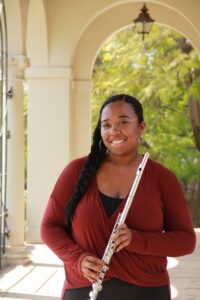
    What BRAVO programs did you participate in during K-6th grade
     when you attended school in Ojai?  What do you most remember? 
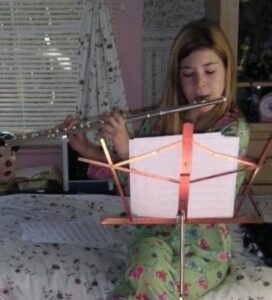
    I went to Summit Elementary, Matilija Middle School and Nordhoff High School. I started singing and playing piano at the age of 6. Going to the BRAVO Imagine concert and performing in High School were enjoyable highlights! I loved the Music Van experience at Ojai Day and chose to play the flute in school. I went on to earn my college degree in classical voice.  
     
    How did your early experiences influence your life now? What are you working in? 
    To have a world-renowned Music Festival in our own tiny little town is so cool and so rewarding. Being able to volunteer there as a teenager was so important to me because it opened my eyes to what classical music could be—it wasn’t just Bach and Beethoven, it could be all these weird, contemporary works that I just loved and they were so inventive. It’s not usual for a someone to be exposed to this music, much less a teenager in a tiny little town. 
     
    How has music impacted your life? What is your involvement with music now? Do you see yourself being involved in music in your future? What are your hopes around that?  
    Performing gives me great pride and peace at the same time. Now I teach children age 3-10 at the Ventura Music Academy. I am one of the vocal directors at Ojai Youth Entertainer Studio. Being able to help young singers find their voice is an awesome thing that I get to do. Working with kids is particularly rewarding and just nourishing for the soul. It really is like passing the baton to them. Contributing to their musical education, when I had so many contribute to mine, is so cool. And I get to pass that on and watch as they grow and their skills and talents just flourish and know that I had a part in that and that they will always remember their formative musical experiences growing up. I’m always so grateful for the opportunities that I get to work with youth. 
     
    I am also involved with Ojai’s theater community, having done several shows at the Ojai Art Center. I sing and get to help to direct Madrigali, Ojai’s local renaissance acapella vocal group.   


    Emily Praetorius

    “It’s quite unmatched in terms of the camaraderie, the friendship and bonding that happens….You really feel like you are part of this family.”

    Growing up in Ojai, Emily recalls receiving free tickets to attend a Festival concert through BRAVO and got her first musical glimpse into the world of Percy Grainger. She went off to college at University of Redlands then applied to the Festival’s Arts Management Internship program where she learned everything from working retail (fond memories of our Penguin Book Booth) to eventually becoming the esteemed Rothenberg Intern Fellow. Now finishing her doctorate in composition at Columbia University under the tutelage of 2017 resident composer George Lewis, Emily continues her love of music and applying what she learned at the Festival in her current path.

    Kathryn Carlson


    Arts Management Intern (2017-2019)
    Cal State Long Beach graduate 


    What interested you in applying to the Festival?
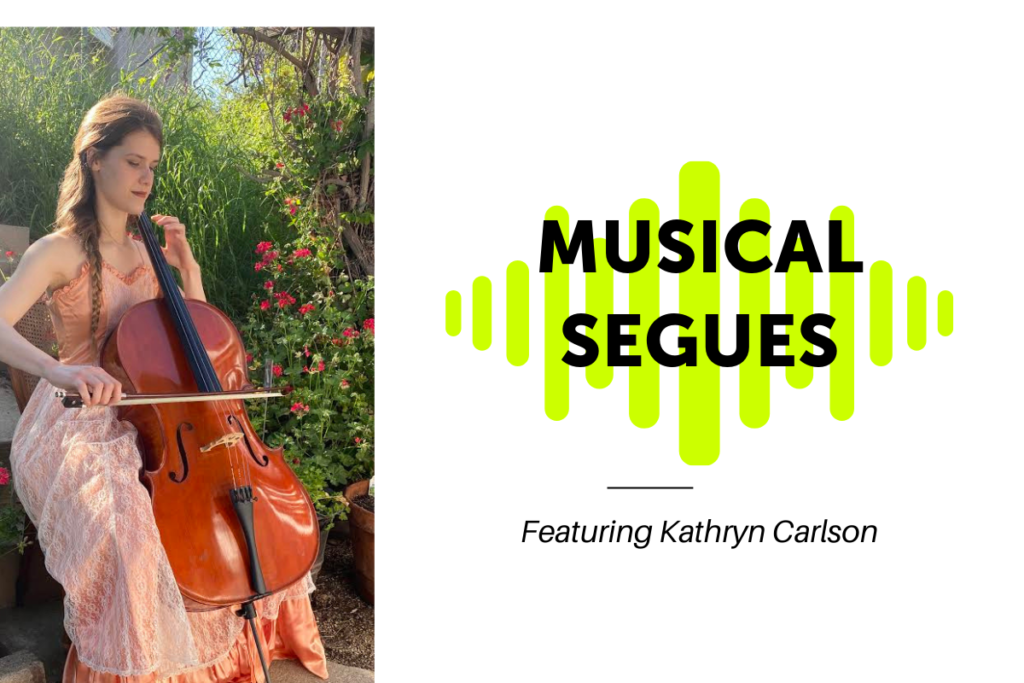
    My first experience with the Ojai Music Festival was as a guest. I was visiting my boyfriend in his hometown of Ojai in the summer of 2016 when he told me that a music festival was going to be happening downtown. I looked into it expecting to find a folk or pop music festival and was surprised to find that it was centered on contemporary classical music. As a trained contemporary classical cellist myself, I knew I had to attend! Peter Sellars was the Music Director in 2016, and that year I was impressed to see that there was a focus on music written by women. To this day one of my favorite memories is laying on the festival lawn absorbing the sounds of Roomful of Teeth singing Caroline Shaw’s Partita for 8 Voices.

    A year later while I was studying at UCSB, our department put out a notice that the Ojai Festival was looking for interns. After what I’d experienced the year before, I had to be involved, and that’s how I ended up applying for the first time in 2017.

    What was my favorite Ojai experience?
    This may sound odd but one of my favorite experiences was when a guest came up to the box office outraged by the music he had heard and demanded his money back because it “wasn’t music” in his opinion. I watched the Box Office Manager at that time calmly have a long, in-depth conversation with the customer about the nature of the piece, and I’ll never forget how such a meaningful conversation had been inspired by an initially negative reaction. The customer walked away with a different mindset, and even though he may not have personally enjoyed that particular performance, many other audience members after the concert came out saying how much they loved what they had just heard. I love that Ojai produces challenging experiences that we can talk about and use to learn about each other.

    What was an a-ha moment working in any of the Festival departments?
    Honestly, an a-ha moment during my first year as an intern was realizing that the core team of the Ojai Music Festival is small. It’s extremely impressive that this small group of people completely transforms a local park into a world-class festival venue in the span of just a week. It’s inspiring that so much can happen with a small, dedicated group of people.

    What are you up to now?
    I graduated just this spring from California State Long Beach with my Masters in Instrumental Performance. I currently have a small studio of cello students and also work part time on the side. I’ve been participating in a virtual ensemble that my housemate started at the beginning of the quarantine called the Philanthropic Philharmonic (@philanthropicphilharmonic) which puts together recordings of musicians from all over in order to raise money for charity. I’ve also been working on making arrangements for one to four cellos that I record myself and edit together. I’m hoping to release some soon once I have them all polished. Follow me @kathrynmakesmusic on Instagram if you’re interested in following my progress!

    Ruben Salinas

    “I find that music is an emotional outlet for me. It’s the thing that gives me the greatest passion.”

    Musical Segues is our ongoing segment of the Ojai Festival’s BRAVO education & community program that introduces alumni, who either went through the BRAVO program via the Ojai Valley public schools or participated in our Festival Arts Management Internship program.

    This month features Ruben Salinas who went through various music programs in the Ojai Valley including our BRAVO in the schools. Raised in Ojai and a graduate from CalState University Northridge’s music program, Ruben has been an active musician playing saxophone in recording studios and concerts for such artists as Eric Burdon, Noble Creatures, Kenny Loggins, and Jewel. In years past before the pandemic, you could also find him sharing his music at Ojai stomping grounds like the Vine. 


    Emily Persinko

    Meet Emily Persinko, who interned with the Ojai Music Festival from 2016 to 2018. After graduating from San Diego State University, Emily has been working in various arts administrator roles for performing arts organizations, which have included the San Diego Symphony, Art of Elan, La Jolla Music Society, San Diego Youth Symphony, and San Diego State University School of Music and Dance.  Emily currently leads the operation of the San Diego Symphony’s learning and community engagement programs and serves as a director on the board for the San Diego Flute Guild.

    Adryon de León

    Nordhoff High School Graduate 
    Adryonmusic.com

    Adryon de León was born and raised in Ojai, CA. Over formative years, musical theater infused her life. She has performed background vocals for Macy Gray, Patti Austin, The Growlers, and George Clinton. In 2013, she joined the acclaimed Los Angeles-based soul & funk group Orgone. Orgone’s most recent release, 
    Reasons, features tracks spotlighting de León in a main writing and collaborative role. She also lends her voice to commercial studio sessions worldwide, demoing tracks for production companies. In Spring 2019, Adryon appeared as “Alana” in a production of The Little Mermaid: Live-to-Film at the Hollywood Bowl, featuring Lea Michele, Harvey Fierstein , Peter Gallagher, Cheech Marin, and Leo Gallo.

    What BRAVO programs did you participate in during K-6th grade when you attended school in Ojai?  What do you most remember?
    I went on an Ojai Music Festival-sponsored field trip to the Imagine Concert at the Libbey Bowl to see LA Philharmonic perform “Peter & the Wolf” for the students!  The exposure to this performance captured the attention of every single child in the audience, for the entire sitting. Sonically, the feeling of the orchestra for the first time was overwhelming. It made me want to pick up my instrument and make some noise.  I played flute in concert band, grades 4-6!  

    How has music impacted your life? What is your involvement with music now? Do you see yourself being involved in music in your future? What are your hopes around that? 
    Music is now my entire life. I transitioned to full time professional vocalist in 2011, touring worldwide with my band Orgone, working in Los Angeles providing vocals for film, television, demos, background vocals, and live performances. Eight years ago was cast at the Disneyland resort as a featured principal performer. 

    I can’t imagine myself not fully immersed in a music career in the future, whether it be as an instructor, mentor, or performer. My hope is to foster a comprehensive music career while I am able and to leave a positive legacy.  

    How did your early experiences influence your life now? What are you working in?
    Music infiltrated every aspect of my life as a child. My mom is musical, my siblings are involved in various projects, and Ojai fostered a beautiful community of artistic kids just like me. I’m currently majoring in Business Administration and working as many studio projects from home as I can. I’m also working on my solo record and collaborating with other artists.  

    Dominique Wright

    Arts Management Intern
    Occidental College, Class of 2020

    What interested you in applying to the Festival?
    I applied to the Festival the summer after my freshman year as my Chamber Music coach told me about the program. I had just gotten into social media marketing at my school (Occidental College) and we agreed this would be a great opportunity to improve those skills as well see what happens behind the scenes – there’s A LOT that goes on.

    Eventually, I went on to intern at the Festival for three years: 2017, 2018 and 2019. During those formative summers, I was able to work in three different areas: marketing, retail and the box office.

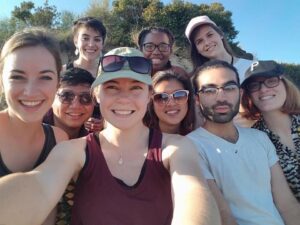
    Enjoying time away from the office with the 2017 Festival interns.

    What was your favorite Ojai experience?
    I have to say my favorite Ojai experience were outings the interns did together. While we all had busy days, we always had time – at least before the Festival started – for ourselves, and most of the time we would go out for dinner, go to the beach or on a hike. These are your colleagues for the two to three weeks while we are in Ojai, so these outings felt like co-workers hanging out and just recharging for the next day.

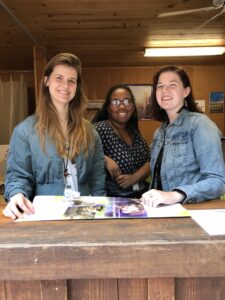
    L-R: Kathryn Carlson, Dominique Wright, Lucy McKnight

    What was an “a-ha” moment working in any of the Festival departments?
    Working in the box office, I was able to interact with patrons and the ticketing system which helped me see where our guests were coming from. There were people who would travel hours to come to the Festival. It was an amazing discovery because it showed the impact it had on people and how music brings people together. That’s something I aim to achieve in my career, whatever that may be!

    What are you up to now?
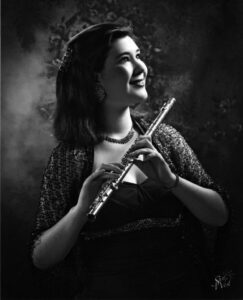
    This past May, I graduated from Occidental College with a BA in Flute performance and a minor in media studies. Currently I am applying to grad programs for arts administration as well as marketing and looking for jobs to gain more experience, and honestly, keeping myself busy in quarantine. Working in the arts field was never a future I saw for myself until interning at the Festival. I’m aware that my future jobs may not be the same as a festival environment, but this internship was what I always looked forward to throughout the school year; knowing that at the end, I get to go back and be with my Ojai family.

    In fact, I’m not the only one who has these career goals, some intern alumni have already started making their mark in the arts workplace, some of which you’ll be hearing from very soon. I look forward to sharing their stories these next several months!

    About the Arts Management Internship program

  • Joan Kemper Way

    Joan Kemper Way

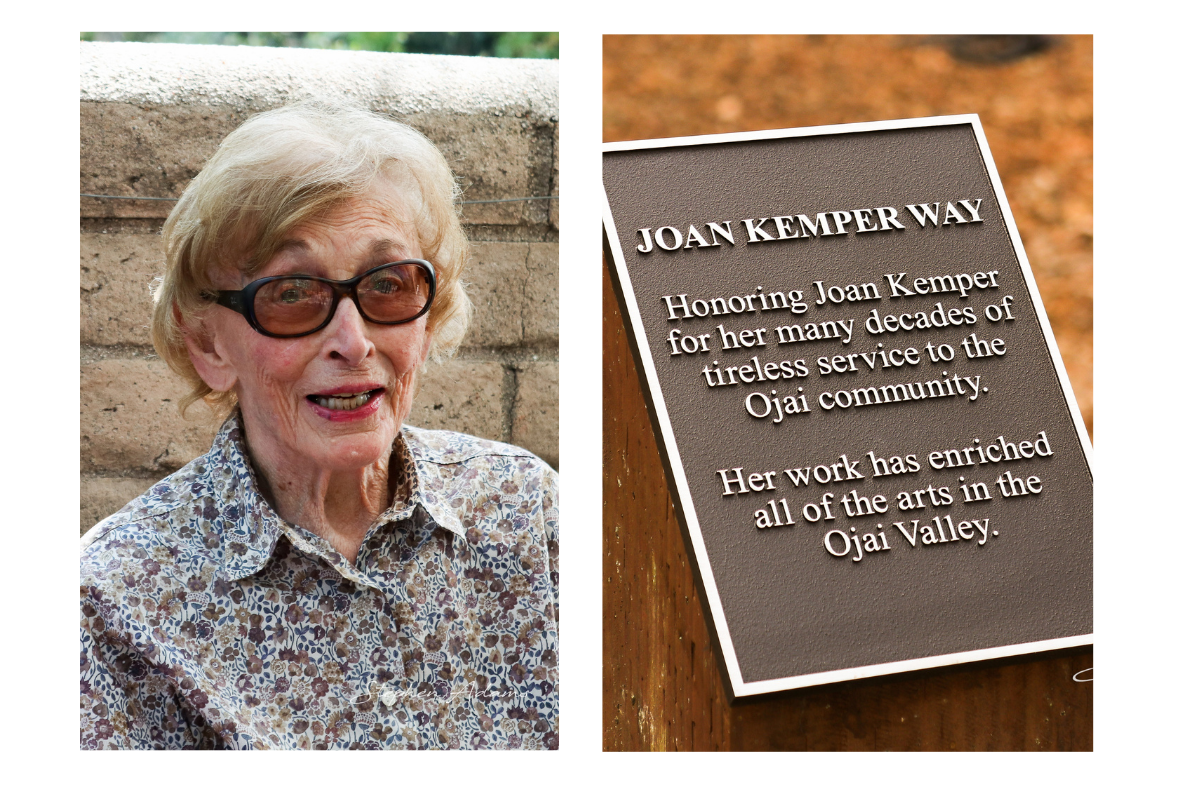
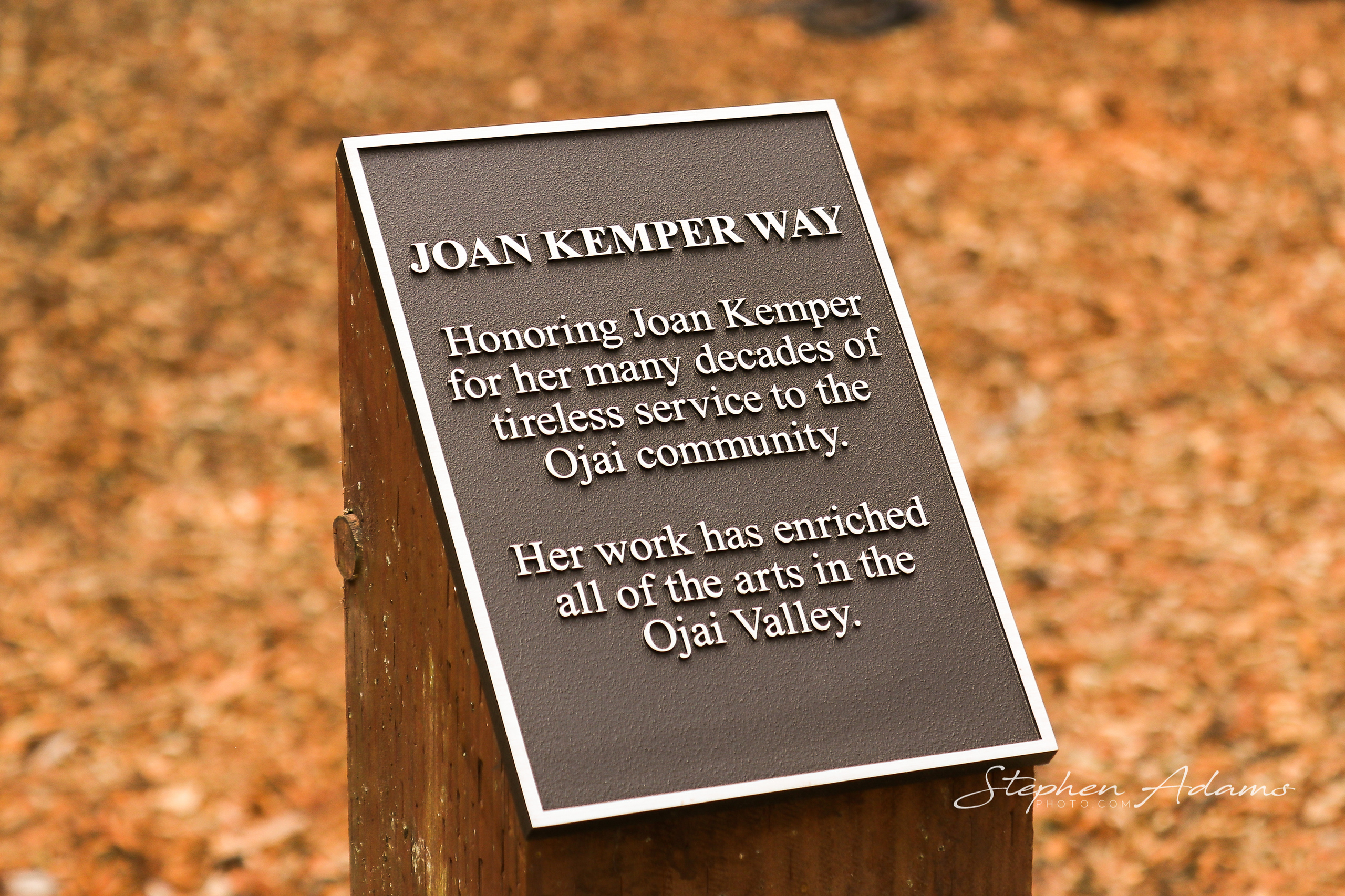
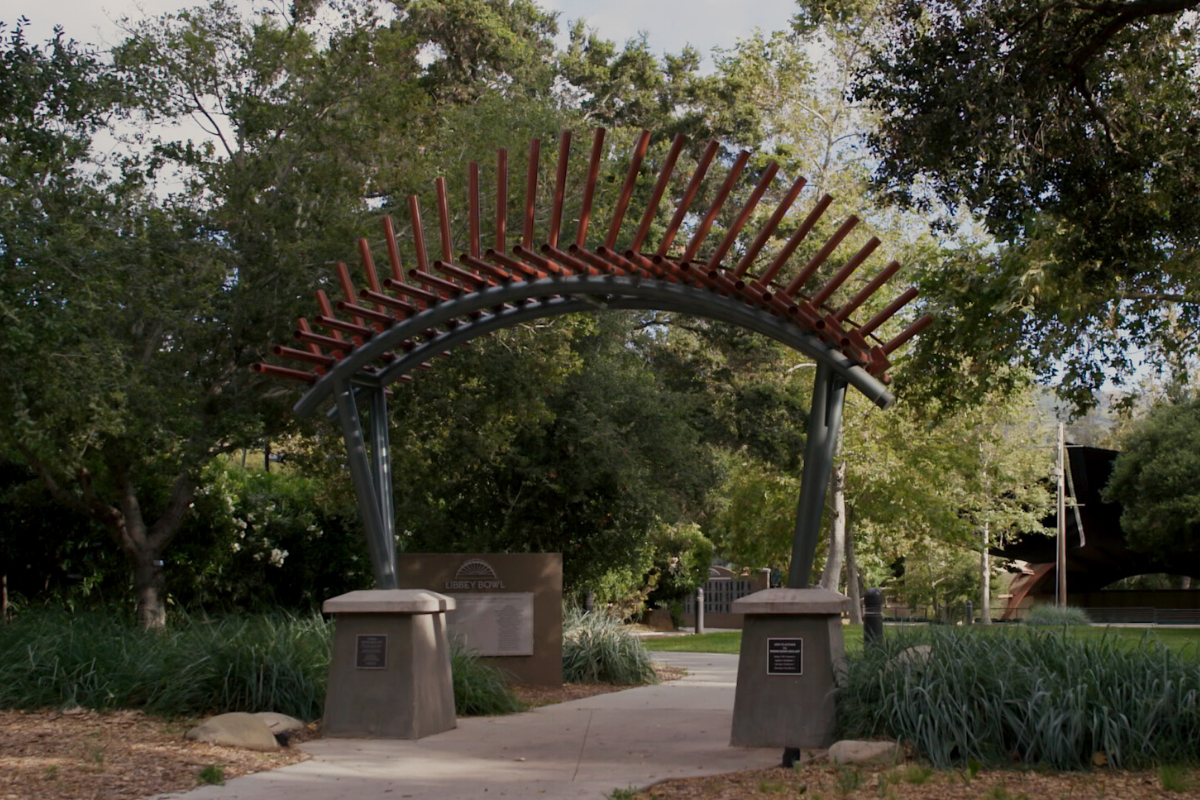
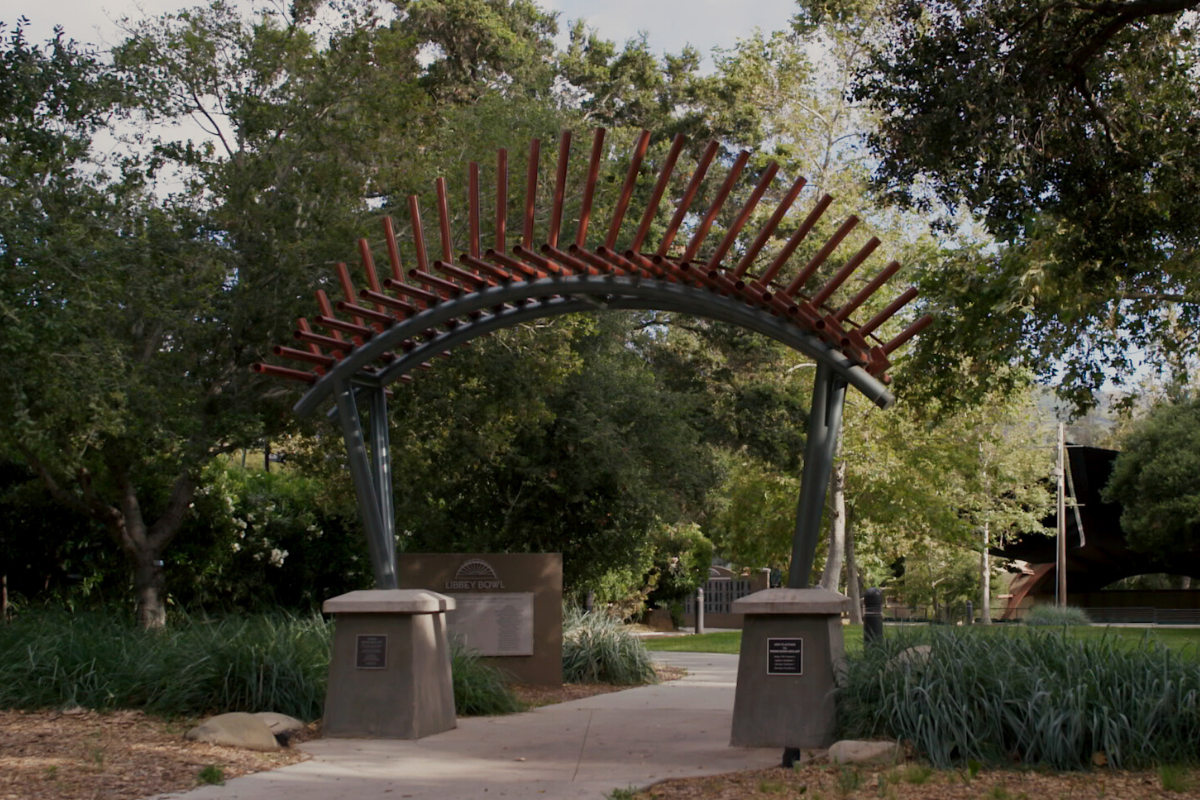
    On a characteristically hot and sunny Ojai September day, a small group of people gathered in Libbey Park to honor Joan Kemper, a true community hero. The path connecting the Ojai Art Center with Libbey Park was officially renamed Joan Kemper Way, honoring a woman who has been central to so many community organizations and so many worthy endeavors throughout Ojai. She is one of those treasures who makes the quality of life better not only for those around her but also for so many people she may never meet.

    Joan was a relatively recent arrival to Ojai when she stepped in to serve as Executive Director of the Ojai Festival in the early 1990s. I had the huge pleasure of working with her for several years and marveled at her boundless gifts for making things happen. She is one of those remarkable people who has never met a problem she couldn’t solve. The Festival was floundering without leadership at the time she took it over – there was no task to large or small for Joan, who is one of the most persuasive and creative problem solvers I’ve ever met.

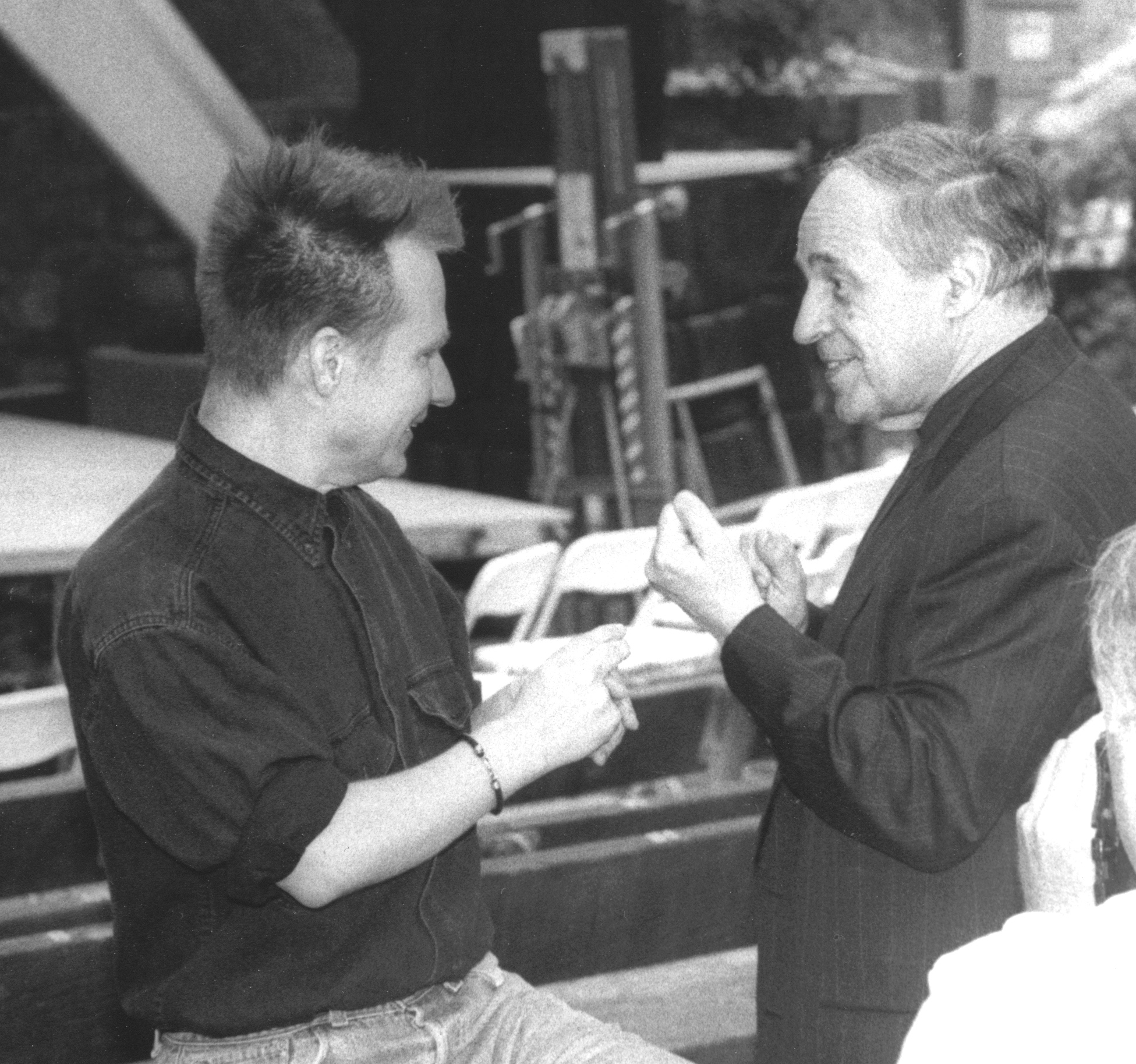
    In one of my fondest memories, Peter Sellars was directing a fresh re-thinking of Stravinsky’s Histoire du Soldat with Music Director Pierre Boulez conducting in 1992. Peter wanted to capture Stravinsky’s original intent of a certain street-theater atmosphere, updated to the present time. And so he wanted to have a full-size pickup truck on stage at Libbey Bowl to capture that spirit. How to find a loaner pickup truck and get it up on stage? Leave it to Joan to draw upon friends across the community to help with getting the truck, creating a series of safe ramps, and getting it up on stage.

    Good things happened whenever Joan is around, particularly throughout the Ojai community. She has a way of rallying people to a common cause, with music and theater being especially close to her heart. She gets you to pitch in and then she makes the whole thing such great fun that you end up thanking her. These days, Joan may slyly say, “you know, I’m basically a hundred years old” – it’s only a slight exaggeration – but her wonderful indefatigable spirit seems to me as lively and inspiring as it was on the day I met her.

    I am grateful, like so many others, to travel on Joan Kemper Way! Long may you brighten our lives, Joan.

    • Ara Guzelimian, Artistic & Executive Director

    Ojai photos by Stephen Adams, Peter Sellers and Pierre Boulez by Betty Freeman

  • Víkingur Ólafsson, piano

    Víkingur Ólafsson, piano

    Pianist Víkingur Ólafsson’s remarkable originality and powerful musical conviction have seen him, in just a few years, take the music world by storm to become one of the most sought-after artists of today. He made an unforgettable impact with the release of his three albums, Philip Glass Piano Works (2017), Johann Sebastian Bach (2018) and Debussy Rameau (2020) on Deutsche Grammophon, for whom he is an exclusive recording artist. Debussy Rameau has already surpassed 21 million streams, bringing Ólafsson’s total streams to over 125 million and leading the Daily Telegraph to call him “The new superstar of classical piano.”

    (more…)

  • Play Music on the Porch – A Virtual Global Effort

    Play Music on the Porch – A Virtual Global Effort


    Now more than ever, creative expression is important to join together even in the virtual world! 

    The Ojai Festival’s BRAVO education & community program is delighted to partner with Porch Gallery Ojai by organizing performances of Ojai-area musicians and students for #PlayMusicOnThePorchDay on Saturday, August 29, beginning at 10am.

    For the fifth time, Porch Gallery Ojai will join in this global effort to continuing the tradition of singing and playing to re-establish music as an inclusive, shared and participatory celebration of life. Set your calendar for August 29 when we will launch music videos, played in porches across the Ojai Valley! Videos can be accessed, here, on our website or on our Facebook page: https://www.facebook.com/ojaifestival/.

    “The BRAVO program is pleased to work with the Porch Gallery Ojai in this year’s Music on the Porch project. Local musicians enrich the BRAVO program throughout the year, and we feel deeply grateful for their contributions once again, to help us all connect through music. The arts can help us build bridges of hope,” shared BRAVO coordinator Laura Walter.

    What is Play Music On The Porch Day?
    In 2013 the founder, Brian Mallman, of Play Music on the Porch Day decided to share the idea – “What if for one day everything stopped…and we all just listened to the music?” –  with the world.  Since then, thousands of musicians from at least 75 countries and over 1450 cities have participated and this movement continues to grow every day with artists, regardless of their differences, are finding common ground through music. Learn more here >

    Ojai’s line-up of wonderful musicians providing music for all to enjoy, and inspire us to revive the tradition of gathering, singing and playing music outside with friends and family virtually and safely social distancing! 

    Chaparral Swing Band
    Celtic Nut (Eilam, Noahm and Edaan Byle)
    Licity Collins
    Fran Gealer
    Coree Kotula 
    Ruby Skye
    Kaylie Turner 
    Babette & Bob Vasquez
    Jess Wayne


    special thanks to our partner:

  • Beginning and Homecoming: Message from Ara Guzelimian

    Beginning and Homecoming: Message from Ara Guzelimian

    Dear Ojai Festival friends, 

    A beginning and a homecoming. It is rare for the two to coincide. A few days ago I experienced a moment of transformation – I stepped down as Provost and Dean of the Juilliard School after 13 ½ rewarding years and became Artistic and Executive Director of the Ojai Festival (I seem to have a thing for compound titles!). Of course, I am hardly new to Ojai, having been associated with the Festival in one capacity or another for several decades now. But this feels like a real homecoming, a return to what I love so dearly. 

    And what a time! We are in the strangest of circumstances, trying to understand practically and philosophically what is meant by “social distancing” when we humans are such fundamentally social creatures. In the midst of all this, the deep underlying fissures of American society burst unstoppably with the horrifying death of George Floyd, another moment in centuries of such horrifying incidents laying bare the disease of racism.  

    We shared in the most meaningful way that we can, which is letting powerful art speak the truth. The Festival brought renewed focus to the world premiere of the first version of Josephine Baker: A Portrait from the 2016 Festival, written by Tyshawn Sorey with words by Claudia Rankine, sung by Julia Bullock and directed by Peter Sellars. 

    Sadly, the 2020 Festival created by Matthias Pintscher and Chad Smith was cancelled in the face of the coronavirus pandemic, taking away the gathering at Libbey Bowl that we all cherish so much. In its place, there was a virtual festival with the joy of keeping company with Matthias Pintscher, Olga Neuwirth, the Calder Quartet, and Steve Reich, all so generously participating to honor the spirit of the planned 74th Festival. It was so incredibly heartening to gather together in multiple Zoom screens of virtual Patron Lounges ahead of each evening’s Festival stream and to have the pleasure of each other’s company in our mutual affection for Ojai and the Festival. Thanks to each of you for participating, watching, sending us some lovely notes, and generously giving financial support to help sustain the Festival in this trying time. We are what we are because of you, especially in these challenging days. 


    Many of you commented on your pleasure in the virtual time spent with Matthias and Olga. I’m delighted that our colleagues at the Pierre Boulez Hall in Berlin have created their own virtual new music festival, anchored by works of Pierre Boulez, with newly written pieces by both Olga and Matthias, so I am happy to direct you to what sounds like an Ojai in Berlin. Click here to view. 

    We have all had our ups and downs during this time of isolation, which makes us doubly grateful for those moments that brighten our spirits. I had just such an experience in a phone call with John Adams, the Music Director of the 2021 Ojai Festival, as we began our planning for what is to be the 75th edition. John and I spoke for an hour just dreaming up ideas about favorite music and musicians, discoveries we couldn’t wait to share with each other, and suddenly the whole perspective shifted – instead of talking about what we were missing in our isolation, we were talking with love and excitement about what will animate Libbey Bowl in a year’s time. It was like breathing oxygen again! 

    Although a milestone anniversary year might suggest a retrospective, John was having none of that. He wants an absolutely forward-facing festival that celebrates the next generation of composers and musicians. Future Forward was born at that moment as the underlying driver of the 2020 Festival. We have invited a number of brilliant young composers and performers to form the core of the coming festival. We also decided to form an all-star, hand-picked ensemble of musicians to form the featured “band” of the Festival, focusing on the incredible talent to be found in California and around the U.S. We will make the first announcement of next year’s Festival near the end of July, and you will be the first to know. Stay tuned! 

    In closing, I can’t help but relay a wonderful experience I have had in the past week. I was to be in Bamberg, Germany to serve on the jury of the Mahler Conducting Competition. Alas, it was not to be as the European Union continued a strict ban on U.S. travelers because of the high incidence of the virus in this country. Happily, I was able to take part virtually, awakening each morning at 3 a.m. to watch the livestreams of the sessions and then participating via Zoom in the jury room deliberations. I was thrilled to work again with the wondrous Barbara Hannigan, a fellow juror doubling as soprano soloist in the closing performance of the Mahler Fourth Symphony. Barbara is an extraordinary artist and human being, as we all well know from our time with her at the 2019 Festival. Her generosity and insight informed the conversations; her luminous singing in the Mahler gave it its closing benediction. You can watch the performance here with the fourth movement beginning at 1:16.50. 

    And in the course of a deeply meaningful week of music and conversations, everything came full circle. The guiding spirit of the competition is Marina Mahler, the composer’s granddaughter, who is an irresistibly vibrant personality. In one of our conversations, I suddenly remembered that she had a long chapter in her childhood in Los Angeles. Her mother, the sculptor Anna Mahler, moved with Marina to Los Angeles to live with Alma Mahler, Gustav’s widow who was then based in Beverly Hills. It was in talking about our Southern California roots that Marina told me that she went to the Ojai Valley School, beginning at the age of seven! Who would have thought that there would be one degree of separation between Gustav Mahler and Ojai . . . .  

    I took that as sign to redouble all our efforts in nourishing and supporting this unlikely treasure in a wooden bowl in a town park in the most heavenly setting. I have always thought of the Ojai Festival as something of a miracle. With your help, I will do all within my abilities to sustain and renew this beloved festival. 

    Next year in Libbey Park! 

    With thanks and warm regards, 

    Ara Guzelimian 
    Artistic and Executive Director 

    P.S. Claire Chase and I have kept up a lively exchange of messages during these past four months as we record and send various experiences of bird song to cheer each other up. Claire has a decided advantage as a flutist! In honor of that exchange, I send you Claire and bird song, as channeled by Dai Fujikara.

  • Boulez, Neuwirth, and Pintscher in Berlin July 9 – August 11

    Boulez, Neuwirth, and Pintscher in Berlin July 9 – August 11

    The Ojai Festival is honored to partner with the Pierre Boulez Hall in Berlin in their online festival of new music, subtitled Distance/Intimacy. The Boulez Hall, designed by our Ojai Festival friend Frank Gehry, has become a vibrant center of new music life in Europe. This particular festival features music by the hall’s namesake, Pierre Boulez, who was Ojai Festival music director seven times in the years between 1967 and 2003. Boulez’s music is surrounded by a series of newly commissioned works by ten stellar present-day composers, including Matthias Pintscher and Olga Neuwirth, most recently heard in the virtual edition of the 2020 Ojai Festival. You can find out much more here. There will be a live stream on four days beginning on July 9, introduced by the festival curators Daniel Barenboim and Emmanuel Pahud. The programs will then be accessible at that website for 30 days beginning July 13.
     
    We happily invite you to join this online musical adventure, which has such sympathetic resonance with the Ojai Festival. But there is also a greater purpose to this collective international effort. Our colleagues at the Boulez Hall have also created this online event in part to bring attention to the severe impact of the coronavirus pandemic on musicians worldwide. Concert halls and festival have gone silent. Countless musicians around the world have suffered devastating financial impact from all of the lost work, an effect most deeply felt by freelance musicians. Musical organizations from around the world have joined with the Boulez Hall to call attention to the plight of musicians and to encourage support of local entities which support freelance musicians. The Ojai Festival asks that you consider making a contribution to two wonderful new music ensembles, which have had such a profound impact literally from coast to coast: the Wild Up in Los Angeles and ICE, the International Contemporary Ensemble in New York. Both these ensemble provide regular work for some on the most imaginative and accomplished musicians in the country. With their concerts now cancelled for months, these ensembles need our support more than ever.
     
    Ara Guzelimian
    Artistic and Executive Director
  • Calder Quartet in a “Quarantine Style” Performance

    Calder Quartet in a “Quarantine Style” Performance

    With works by Cage, Stravinsky, Ockeghem interspersed with arrangements by Kurtág, and Beethoven to reflect on the new and old.

  • Ara Guzelimian

    Ara Guzelimian is Artistic and Executive Director of the Ojai Music Festival, beginning in that position in July 2020. The appointment culminates many years of association with the Festival, including tenures as director of the Ojai Talks at the Festival and as Artistic Director 1992-97.

    Ara Guzelimian stepped down as Provost and Dean of the Juilliard School in New York City in June 2020, having served in that position since 2007. At Juilliard, he worked closely with the President in overseeing the faculty, curriculum and artistic planning of the distinguished performing arts conservatory in all three of its divisions – dance, drama and music. He continues at Juilliard in the role of Special Advisor

    Prior to the Juilliard appointment, he was Senior Director and Artistic Advisor of Carnegie Hall from 1998 to 2006. Guzelimian serves as artistic consultant for the Marlboro Music Festival and School in Vermont. He is a member of the steering committee of the Aga Khan Music Awards, the artistic committee of the Borletti-Buitoni Trust in London, and a board member of the Amphion and Pacific Harmony Foundations. He is also a member of the music visiting committee of the Morgan Library and Museum in New York City.

    Previously, Guzelimian held the position of Artistic Administrator of the Aspen Music Festival and School in Colorado, and he was long associated with the Los Angeles Philharmonic, first as producer for the orchestra’s national radio broadcasts and, subsequently, as Artistic Administrator. Guzelimian is editor of Parallels and Paradoxes: Explorations in Music and Society (Pantheon Books, 2002), a collection of dialogues between Daniel Barenboim and Edward Said. In September 2003, he was awarded the title Chevalier des Arts et des Lettres by the French government for his contributions to French music and culture.

  • Sunday June 14th Virtual Concert

    Sunday June 14th Virtual Concert

    Press Play; Click Box Above to Go Full Screen [  ]


    Concert Notes

    STEVE REICH (b. 1936) 
    Drumming (1971) 

    A Concert for Ojai: Pulses and Patterns 

    The 2020 Ojai Music Festival programs designed by Matthias Pintscher have alluded to numerous threads and connections, bridges and transitions — all resulting in the enticingly varied menu of today’s scene. We’ve encountered a mixture of leading European and American composers, reflected on Pierre Boulez and his ties to the natural setting of Ojai, and sampled from the legacy of figures from the post-Boulez generation like Olga Neuwirth, Unsuk Chin, and Pintscher himself. The music of Steve Reich completes this summer of creative juxtapositions — and fills in a missing link between the realms of European and American musical innovation. 

    But first, we turn to a pair of pieces by two other contemporary composers to start off this Concert for Ojai. Based in her native Mexico City, where she grew up in a family devoted to the traditions of Mexican folk music, Gabriela Ortiz explores intersections between the realms of avant-garde, jazz, and folk. Her opera Camelia La Tejana: Only the Truth was presented by Long Beach Opera in 2013. Written to celebrate the 30th anniversary of the Cuarteto LatinoamericanoLío de 4 is a brief and playful piece that focuses on the potential of rhythmic elegance and vitality. 

    A generation younger and a native of Puerto Rico, Brooklyn-based Angélica Negrón is a composer and multi-instrumentalist who has received accolades for her idiosyncratic use of toys, electronics, and robotic instruments. One of her current projects, for National Sawdust, is Chimera, a work-in-progress she describes as “a lip sync opera for drag queen performers and chamber ensemble exploring the ideas of fantasy and illusion as well as the intricacies and complexities of identity.” 

    Triste Silencio Programático (2002) is one of Negrón’s first compositions and was inspired by the 1920 silent film The Cabinet of Dr. Caligari as well as by the aesthetic of German Expressionist cinema. Directed by Robert Wiene and written by Hans Janowitz and Carl Mayer, Dr. Caligari involves “an insane hypnotist [who] uses a somnambulist to commit a series of crimes,” the composer explains. “At that time, I played violin and Celtic harp in a band called Sinestesia and one of our earliest gigs was to compose and perform a live score to go along with this film.”  

    Triste Silencio Programático draws on some of the themes she wrote for this score. “The first movement focuses on the dark mood of the film as well as the visual style with its unusual angles and distorted sets,” writes Negrón. “The second movement examines the dramatic contrast between light and shadow, while the third movement explores the destabilized characters and their inner mind with their complex psychological states. Triste Silencio Programático is a piece of music in black and white.” 

    It was during the 1966 Summer Festival (programmed by Ingolf Dahl) that Steve Reich’s music made its Ojai debut: Michael Tilson Thomas played his Two Fugues for Piano. By an ironic coincidence, Boulez paid his first visit to Ojai that same year. His inaugural season as music director followed in 1967, and Boulez would return over the span of nearly four decades as music director at Ojai more often than any other artist. Yet he had a blind spot for major contemporary American composers. Dismissive of Minimalism in general, he never programmed any Reich. Yet the Ensemble intercontemporain, founded by Boulez himself, would later commission Reich and won his admiration for its precision perfection in interpreting his music.  

    Completed in 1971 after a year of work, Drumming is one of the acknowledged early masterpieces of Minimalism and a pivotal work in Reich’s development. On the surface, it must have seemed far removed from the concerns of Boulez and his fellow avant-gardists in Western Europe — with the exception of György Ligeti. Reich once referred to Ligeti as “the European composer who has best understood both American and non-Western music.”  

    Reich’s teenage love of jazz — in particular, Kenny Clark’s artists with the Modern Jazz Quartet — led him to take up percussion and form his own band. In 1970, a few years after his breakthrough experiment with phase music [see sidebar], Reich traveled to Ghana to study the indigenous drumming traditions of the Ewe people. Ligeti would follow his lead in the next decade, similarly drawing inspiration from African sources.  

    Through close study with a master drummer of the Ewe tribe in Accra and his daily recording of lessons, Reich familiarized himself with the patterns and structures of African drumming. The most important influence of his stay in Africa, according to the composer, is that “it confirmed my intuition that acoustic instruments could be used to produce music that was genuinely richer in sound than that produced with electronic instruments.” Upon his return to the United States, he composed Drumming, which was premiered by the Steve Reich Ensemble at the Museum of Modern Art (in the film theater) in New York City in 1971.  

    Depending on the number of repeats that are played in performance, Drumming lasts between 55 and 75 minutes and is Reich’s longest composition. His unusual scoring calls for four tuned bongo drums, three marimbas, three glockenspiels, and piccolo, plus an alto and a soprano; whistling is also part of the soundscape, contributed by one of the singers or a percussionist. Reich recalls that the long decay of the marimba is what suggested the idea of incorporating women’s voices, which sing the “sub-patterns” that result acoustically from this resonance. He also compares the vocal patterns to Ella Fitzgerald’s style of scat singing, which he listened to often while exploring jazz in his early years. A similar process results in the whistling and piccolo patterns in the glockenspiel and final ensemble sections.  

    Notice the absence of bass instruments — in fact, the first three parts of the four-part work spiral successively upward in timbre until all of the forces join together in the fourth and final part. The whole work is shaped from a single core pattern. As Reich describes it: “Drumming begins with two drummers building up the basic rhythmic pattern of the entire piece from a single drum beat, played in a cycle of twelve beats with rests on all the other beats. Gradually, additional drumbeats are substituted for the rests, one at a time, until the pattern is completed. The reduction process is simply the reverse, where rests are gradually substituted for the beats, one at a time, until only a section leads to a build-up for the drums, marimbas, and glockenspiels simultaneously.” 

     Thomas May  

    [SIDEBAR] Phase Music  

    In the mid-1960s, Reich experimented with material he taped from an African American San Francisco street preacher named Brother Walter. He lined up identical loops taped live from Brother Walter’s fire-and-brimstone speech-song commentary on Noah and the Flood and played them back on two cheap machines. By accident, the machines grew slightly out of sync with each other as they continued playing from the same starting point. This overlapping echo created fascinating rhythmic patterns in which the identical strands slowly separated as they went out of phase and then came together again in cycles. By manipulating the phasing — multiplying the individual strands and so forth — Reich found that he could build a dense web that acquires a hallucinatory quality as it lifts the listener outside ordinary time. 

    STEVE REICH (b. 1936) 
    Tehillim (1981)

    Spotify Playlist
    Apple Music

    Fire, Metal, and Praise   

    A Hebrew title graces Tehillim, a landmark composition in Steve Reich’s long career. “Western music before 1750 and from Debussy onwards, as well as jazz and non-Western music, are the sources from which I’ve drawn almost everything,” Steve Reich once observed. Within the rich spectrum of those non-Western musical sources can be found Ghanaian drumming, Balinese gamelan, and the Sephardic music he encountered in the mid-1970s in Israel.  

    The last involved a fresh encounter with Reich’s own roots and has born fruit in numerous compositions that reflect on the meaning of Jewish tradition and philosophy. Tehillim, composed in 1980, is the first of these — and Reich’s first piece incorporating voices since the mid-1960s, when he experimented with taped material. Here, he scores for four female voices plus chamber ensemble (with voices, winds, and strings amplified). 

    Referring to the Biblical Psalms attributed to David, Tehillim literally means “praises,” Reich explains, adding that the word derives from the same three-letter Hebrew root as does “Hallelujah.” The work is divided into four parts based, respectively on these Psalms (Hebrew sources are followed by the equivalent Christian translations shown in parentheses): 19:2-5 (19:1-4), 34:13-15 (34:12-14), 18:26-27 (18:25-26), and 150:4-6. 

    “One of the reasons I chose to set Psalms as opposed to parts of the Torah or Prophets,” according to Reich, “is that the oral tradition among Jews in the West for singing Psalms has been lost. (It has been maintained by Yemenite Jews.) This meant that I was free to compose the melodies for Tehillim without a living oral tradition to either imitate or ignore.” Handclapping, rattles, tuned tambourines without jingles, and small pitched cymbals are the closest analogues he uses to instruments that would have made music in the Biblical period. “Beyond this, there is no musicological content to Tehillim. No Jewish themes were used for any of the melodic materials.” The rhythms of the texts suggest the musical rhythms. 

    For the first text, Reich implements a sequence of canons leading up to all four voices in canon on each of the text’s four verses. A transition on the drum leads to two- or three-voice harmony for Psalm 34, with English horn, clarinet, drums, and clapping interwoven into the texture. The attention to melody here is inspired by Reich’s experiences of Sephardic cantillation.  

    The third part (Psalm 18), a slow movement, is unusually chromatic and begins as a duet between two of the voices. Ending with Psalm 150, Reich recapitulates ideas from the first three parts, returning to the opening tempo, and ends with full ensemble for a setting of Halleluyah. 

    —Thomas May 

    Program Book


    Artist Bios

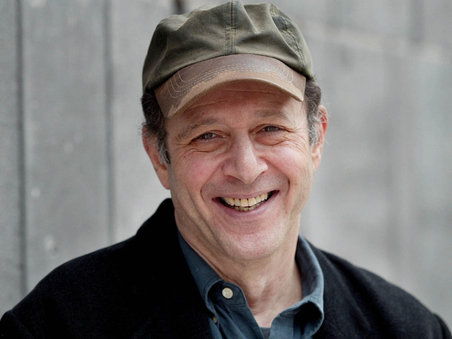
    Steve Reich, Composer

    Steve Reich was recently called  “our greatest living composer” (The New York Times), “America’s greatest living composer.” (The Village VOICE), “…the most original musical thinker of our time” (The New Yorker) and “…among the great composers of the century” (The New York Times).. From his early taped speech pieces It’s Gonna Rain (1965) and Come Out (1966) to his and video artist Beryl Korot’s digital video opera Three Tales (2002), Mr. Reich’s path has embraced not only aspects of Western Classical music, but the structures, harmonies, and rhythms of non-Western and American vernacular music, particularly jazz. “There’s just a handful of living composers who can legitimately claim to have altered the direction of musical history and Steve Reich is one of them,” states The Guardian (London).

    In April 2009 Steve Reich was awarded the Pulitzer prize in Music for his composition ‘Double Sextet’.

    Performing organizations around the world marked Steve Reich’s 70th- birthday year, 2006, with festivals and special concerts. In the composer’s hometown of New York, the Brooklyn Academy of Music (BAM), Carnegie Hall, and Lincoln Center joined forces to present complementary programs of his music, and in London, the Barbican mounted a major retrospective. Concerts were also presented in Amsterdam, Athens, Brussels, Baden-Baden, Barcelona, Birmingham, Budapest, Chicago, Cologne, Copenhagen, Denver, Dublin, Freiburg, Graz, Helsinki, Los Angeles, Paris, Porto, Vancouver, Vienna and Vilnius among others. In addition, Nonesuch Records released its second box set of Steve Reich’s works, Phases: A Nonesuch Retrospective, in September 2006. The five-CD collection comprises fourteen of the composer’s best-known pieces, spanning the 20 years of his time on the label.

    In October 2006 in Tokyo, Mr. Reich was awarded the Preamium Imperial award in Music. This important international award is in areas in the arts not covered by the Nobel Prize. Former winners of the prize in various fields include Pierre Boulez, Lucian Berio, Gyorgy Ligeti, Willem de Kooning, Jasper Johns, Richard Serra and Stephen Sondheim.

    In May 2007 Mr. Reich was awarded The Polar Prize from the Royal Swedish Academy of music. The prize was presented by His Majesty King Carl XVI Gustaf of Sweden. The Swedish Academy said: “…Steve Reich has transferred questions of faith, society and philosophy into a hypnotic sounding music that has inspired musicians and composers of all genres.” Former winners of the Polar Prize have included Pierre Boulez, Bob Dylan, Gyorgi Ligeti and Sir Paul McCartney.

    In December 2006 Mr. Reich was awarded membership in the Franz Liszt Academy in Budapest and in April 2007 he was awarded the Chubb Fellowship at Yale University. In May 2008 he was elected to the Royal Swedish Academy of Music.

    Born in New York and raised there and in California, Mr. Reich graduated with honors in philosophy from Cornell University in 1957. For the next two years, he studied composition with Hall Overton, and from 1958 to 1961 he studied at the Juilliard School of Music with William Bergsma and Vincent Persichetti. Mr. Reich received his M.A. in Music from Mills College in 1963, where he worked with Luciano Berio and Darius Milhaud.

    During the summer of 1970, with the help of a grant from the Institute for International Education, Mr. Reich studied drumming at the Institute for African Studies at the University of Ghana in Accra. In 1973 and 1974 he studied Balinese Gamelan Semar Pegulingan and Gamelan Gambang at the American Society for Eastern Arts in Seattle and Berkeley, California. From 1976 to 1977 he studied the traditional forms of cantillation (chanting) of the Hebrew scriptures in New York and Jerusalem.

    In 1966 Steve Reich founded his own ensemble of three musicians, which rapidly grew to 18 members or more. Since 1971, Steve Reich and Musicians have frequently toured the world, and have the distinction of performing to sold-out houses at venues as diverse as Carnegie Hall and the Bottom Line Cabaret.

    Mr. Reich’s 1988 piece, Different Trains, marked a new compositional method, rooted in It’s Gonna Rain and Come Out, in which speech recordings generate the musical material for musical instruments. The New York Times hailed Different Trains as “a work of such astonishing originality that breakthrough seems the only possible description….possesses an absolutely harrowing emotional impact.” In 1990, Mr. Reich received a Grammy Award for Best Contemporary Composition for Different Trains as recorded by the Kronos Quartet on the Nonesuch label.

    In June 1997, in celebration of Mr. Reich’s 60th birthday, Nonesuch released a 10-CD retrospective box set of Mr. Reich’s compositions, featuring several newly-recorded and re-mastered works. He won a second Grammy award in 1999 for his piece Music for 18 Musicians, also on the Nonesuch label. In July 1999 a major retrospective of Mr. Reich’s work was presented by the Lincoln Center Festival. Earlier, in 1988, the South Bank Centre in London, mounted a similar series of retrospective concerts.

    In 2000 he was awarded the Schuman Prize from Columbia University, the Montgomery Fellowship from Dartmouth College, the Regent’s Lectureship at the University of California at Berkeley, an honorary doctorate from the California Institute of the Arts and was named Composer of the Year by Musical America magazine.

    The Cave, Steve Reich and Beryl Korot’s music theater video piece exploring the Biblical story of Abraham, Sarah, Hagar, Ishmael and Isaac, was hailed by Time Magazine as “a fascinating glimpse of what opera might be like in the 21st century.” Of the Chicago premiere, John von Rhein of the Chicago Tribune wrote, “The techniques embraced by this work have the potential to enrich opera as living art a thousandfold….The Cave impresses, ultimately, as a powerful and imaginative work of high-tech music theater that brings the troubled present into resonant dialogue with the ancient past, and invites all of us to consider anew our shared cultural heritage.”

    Three Tales, a three-part digital documentary video opera, is a second collaborative work by Steve Reich and Beryl Korot about three well known events from the twentieth century, reflecting on the growth and implications of technology in the 20th century: Hindenburg, on the crash of the German zeppelin in New Jersey in 1937; Bikini, on the Atom bomb tests at Bikini atoll in 1946-1954; and Dolly, the sheep cloned in 1997, on the issues of genetic engineering and robotics. Three Tales is a three act music theater work in which historical film and video footage, video taped interviews, photographs, text, and specially constructed stills are recreated on computer, transferred to video tape and projected on one large screen. Musicians and singers take their places on stage along with the screen, presenting the debate about the physical, ethical and religious nature of technological development. Three Tales was premiered at the Vienna Festival in 2002 and subsequently toured all over Europe, America, Australia and Hong Kong. Nonesuch is releasing a DVD/CD of the piece in fall 2003.

    Over the years, Steve Reich has received commissions from the Barbican Centre London, the Holland Festival; San Francisco Symphony; the Rothko Chapel; Vienna Festival, Hebbel Theater, Berlin, the Brooklyn Academy of Music for guitarist Pat Metheny; Spoleto Festival USA, West German Radio, Cologne; Settembre Musica, Torino, the Fromm Music Foundation for clarinetist Richard Stoltzman; the Saint Louis Symphony Orchestra; Betty Freeman for the Kronos Quartet; and the Festival d’Automne, Paris, for the 200th anniversary of the French Revolution.

    Steve Reich’s music has been performed by major orchestras and ensembles around the world, including the London Symphony Orchestra conducted by Michael Tilson Thomas, New York Philharmonic conducted by Zubin Mehta; the San Francisco Symphony conducted by Michael Tilson Thomas; The Ensemble Modern conducted by Bradley Lubman, The Ensemble Intercontemporain conducted by David Robertson, the London Sinfonietta conducted by Markus Stenz and Martyn Brabbins, the Theater of Voices conducted by Paul Hillier, the Schoenberg Ensemble conducted by Reinbert de Leeuw, the Brooklyn Philharmonic Orchestra conducted by Robert Spano; the Saint Louis Symphony conducted by Leonard Slatkin; the Los Angeles Philharmonic conducted by Neal Stulberg; the BBC Symphony conducted by Peter Eötvös; and the Boston Symphony Orchestra conducted by Michael Tilson Thomas.

    Several noted choreographers have created dances to Steve Reich’s music, including Anne Teresa de Keersmaeker (“Fase,” 1983, set to four early works as well as”Drumming,”1998 and “Rain” set to “Music for 18 Musicians”), Jirí Kylían (“Falling Angels,” set to “Drumming Part I”), Jerome Robbins for the New York City Ballet (“Eight Lines”) and Laura Dean, who commissioned “Sextet”. That ballet, entitled “Impact,” was premiered at the Brooklyn Academy of Music’s Next Wave Festival, and earned Steve Reich and Laura Dean a Bessie Award in 1986. Other major choreographers using Mr. Reich’s music include Eliot Feld, Alvin Ailey, Lar Lubovitch, Maurice Bejart, Lucinda Childs, Siobhan Davies and Richard Alston.

    In 1994 Steve Reich was elected to the American Academy of Arts and Letters, to the Bavarian Academy of Fine Arts in 1995, and, in 1999, awarded Commandeur de l’ordre des Arts et Lettres.

    Sunday Playlist

    Sunday, June 14, 2020 | 8:30-9:30am 
    Libbey Bowl 

    MATTHIAS PINTSCHER        4° quartetto darchi (Ritratto di Gesualdo”)          
                                                                                                              Calder Quartet  

    SALVATORE SCIARRINO     Gesualdo senza parole (a 400 anni dalla morte) 
                                                                                                    I. Libro III: XI. “Non t’amo
                                                                                                    II. Libro XIV: XI. “Sparge la morte
                                                                                                    III. Libro VI: I. “Se la mia morte brami
                                                                                                    IV. Libro VI: II. “Beltà poi che t’assenti”  
                                                                                                              Ensemble intercontemporain (EIC) 
                                                                                                              Matthias Pintscher conductor  

    J.S. BACH    Contrapunctus Nos. 1, 3, 4, and 9 from The Art of the FugueBWV 1080           
                                                                                                             Calder Quartet  

    PIERRE BOULEZ    Mémoriale (explosante-fixe… Originel) 
                                                                                                             EIC 
                                                                                                             Matthias Pintscher conductor 

    Sunday, June 14, 2020 | 11:00am-12:30pm 
    Libbey Bowl 

    EDGARD VARÈSE    Octandre 
                                                          I. Assez lent 
                                                          II. Trèsvif et nerveux 
                                                          III. Grave-Animé et jubilatoire 
                                                                                                            Ensemble intercontemporain (EIC) 

    FRANK ZAPPA    The Perfect Stranger  
                                                                                                            EIC  
                                                                                                            Matthias Pintscher conductor 

    GUSTAV MAHLER Das Lied von der Erde (arr. Glenn Cortese)
                                                          Das Trinklied vom Jammer der Erde” (“The Drinking Song of Earth’s Sorrow”) 
                                                          Der Einsame im Herbst (“The Solitary One in Autumn”) 
                                                          Von der Jugend (“Of Youth”) 
                                                          Von der Schönheit (“Of Beauty”) 
                                                          Der Trunkene im Frühling (“The Drunkard in Spring”) 
                                                          Der Abschied (“The Farewell”) 
                                                                                                            Tamara Mumford mezzo-soprano 
                                                                                                            Andrew Staples tenor   
                                                                                                            EIC  
                                                                                                            Matthias Pintscher conductor 

    GABRIELA ORTIZ    Lío de 4   

    ANGÉLICA NEGRÓN      Triste Silencio Programático 
                                                                                                            Calder Quartet  

    STEVE REICH        Tehillim 
    (Spotify Playlist)
    (Apple Music)
                                                                                                            LA Phil New Music Group 
                                                                                                            Paolo Bortolameolli conductor  

    STEVE REICH        Drumming 
                                                                                                            Percussion All Stars  

  • Saturday June 13th Virtual Concert

    Saturday June 13th Virtual Concert

    Press Play; Click Box Above to Go Full Screen [  ]


    Concert Notes

    JOHN CAGE (1912-1992) 
    String Quartet in Four Parts (1950) 

    Seasons of the Sublime  

     In 1946, just one year before the Ojai Music Festival was founded, John Cage had a life-changing encounter with the Indian singer and tabla player Gita Sarabhai. “She was concerned about the influence Western music was having on traditional Indian music, and she’d decided to study Western music for six months with several teachers and then return to India to do what she could to preserve the Indian traditions,” Cage wrote. He offered to teach her for free if she would in turn help him understand Indian music. 

     The mutual exchange left a profound mark on Cage, who was coping with personal crisis during these years. When Sarabhai introduced him to the Gospel of Sri Ramakrishna, the effect was so powerful that it “took the place of psychoanalysis,” he remarked. Cage recalled that from Sarabhai he learned that “the purpose of music is to sober and quiet the mind, thus making it susceptible to divine influences.” Along with aesthetic and metaphysical ideas from Hinduism, Cage also continued to explore his ongoing interest in Zen Buddhism and its concepts of silence and mindfulness.  

     The Sonatas and Interludes for prepared piano explored what Cage called the “‘permanent emotions’ of Indian tradition … and their common tendency toward tranquility.” He turned to the Hindu understanding of the annual cycle in  his 1947 ballet The Seasons (with Lou Harrison contributing his efforts as an orchestrator). In String Quartet in Four Parts, composed between 1949 and 1950 and dedicated to Harrison, Cage again used the cycle of seasons as understood in Hinduism as a framework, tracing the phases of creation, preservation, destruction, and quiescence (which are associated with spring, summer, fall, winter, respectively).  

     Cage traveled to Europe in 1949 — where he met and was initially championed by Pierre Boulez — and started composing the quartet while in Paris during the summer: hence, the work begins with the season of “preservation.” The tempo seems to slow down gradually to near stasis for the third part (winter) and then suddenly quickens for the season of creative renewal, spring.  

     But within this familiar, four-movement context, Cage’s sound world is alien and often bewildering. The material comprises a kind of palette (Cage called it a “gamut”) of previously organized, fixed sonorities, each of which remains unchanged each time it recurs. The light touch and lack of vibrato he requests result in a weirdly archaic, not-quite-early-music sound.  

     If such austere melodies generate an aura of calm illumination, Matthias Pintscher’s Uriel is “about resonances, about the inward and outward givens of existence, about life itself,” as he observes. Hebrew titles are found throughout his oeuvre — as with bereshit and nur, both of which would have already been performed at this year’s Festival — though Uriel is also recognized in English as one of the principal figures in the hierarchy of angels — described by Milton as the “sharpest sighted spirit in all of Heaven” and cast as a tenor narrator in Haydn’s Creation 

     The Hebrew word itself means “light of God.” The archangel Uriel is additionally associated with “God’s fire,” the sun, illumination, and artistic inspiration. Pintscher wrote Uriel in 2011-12 but later made it the final panel in a chamber triptych he calls Profiles of Light. The cycle begins with Now I, a work for solo piano in homage to his great mentor Pierre Boulez on his 90th birthday, and Now II for solo cello (both from 2015).  

     The names of all three pieces derive from the work of the American abstract expressionist Barnett Newman. His essay The Sublime Is Now points to the ways in which American abstract artists “free from the weight of European culture” (in 1947) reassert the “natural desire for the exalted.”  

     Pintscher, an avid collector of visual art, was especially drawn to the essence Newman distills in his painting Uriel (1955): “The closer Newman got to death, the more luminous his work became,” he says. Pintscher chose the cello as a highly suitable instrument for depicting such existential conditions” — mediating between the inward and outward illumination signified by the angel. 

     Following Cage’s elate stasis and Pinscher’s exquisite, visionary dialogue between cello and piano, Charles Ives’s Second String Quartet stages a stunning range of confrontations. The composer supplied a terse program of his own: “Four men — who converse, discuss, argue (in re ‘Politick’), fight, shake hands, shut up — then walk up the mountainside to view the firmament.” Along the way, their discourse is a far remove from Goethe’s “conversation between four reasonable, intelligent people.”  

     Annoyed by what he perceived as the affected refinement of the classical European tradition of quartet playing, Ives produced one of his most challenging, most maverick creations in the Second Quartet. He composed it between 1911 and 1913 but drew on earlier material; the work was not premiered until 1946 at Juilliard.  

     Woven into the score as expected with Ives, is an abundance of musical quotations, both vernacular American tunes and the flotsam of Old World tradition (Beethoven’s “Ode to Joy”) — all set against a sinewy atonal background. The final, transcendent movement in particular sets a snippet from Tchaikovsky’s Pathétique against “Nearer My God to Thee.” 

     Thomas May  

    Program Book


    Artist Bios

    Calder Quartet

    Benjamin Jacobson, violin
    Tereza Stanislav, violin
    Jonathan Moerschel, viola
    Eric Byers, cello

    Hailed as “Superb” and “imaginative, skillful creators” by the New York Times, the Calder Quartet captivates audiences exploring a broad spectrum of repertoire, always striving to fulfill the composer’s vision in their performances. The group’s distinctive artistry is exemplified by a musical curiosity brought to everything they perform and has led them to be called “one of America’s most satisfying – and most enterprising – quartets”. (Los Angeles Times)

    Winners of the prestigious 2014 Avery Fisher Career Grant, they are widely known for the discovery, commissioning, recording and mentoring of some of today’s best emerging composers. In addition to performances of the complete Beethoven and Bartok quartets, the Calder Quartet’s dedication to commissioning new works has given rise to premieres of dozens of string quartets by established and up-and-coming composers including Peter Eötvös, Andrew Norman, Christopher Rouse, Ted Hearne and Christopher Cerrone. Inspired by innovative American artist Alexander Calder, the Calder Quartet’s desire to bring immediacy and context to the works they perform creates an artfully crafted musical experience.

    Recent highlights include Carnegie Hall, Kennedy Center, Disney Hall, Lincoln Center, Metropolitan Museum of Art, multiple performances at Wigmore Hall, Barbican, Salzburg Festival, Donaueschingen Festival, Frankfurt Alte Oper, Tonhalle Zurich, IRCAM Paris, Hamburg’s Elbphilharmonie and the Sydney Opera House. They have performed as soloists with the Cleveland Orchestra and LA Philharmonic and have collaborated with musicians such as Thomas Adès, Peter

    Eötvös, Anders Hillborg, Daniel Bjarnasson, Andrew Norman, Audrey Luna, Johannes Moser, Joshua Bell, Menahem Pressler, Joseph Kalechstein, Paul Neubauer, Iva Bittová and Edgar Meyer. In 2017, the Calder Quartet signed an exclusive, multi-disc record deal with Pentatone with their debut recording featuring Beethoven scheduled for release in Fall 2018.

    The quartet has signed an exclusive, multi-disc record deal with Pentatone records. Their debut recording features the music of Beethoven and Swedish composer Anders Hillborg. Previously the quartet has appeared on Signum Classics, BMC records, Bridge Records and E1 recording the quartets of Peter Eötvös with Audrey Luna, Thomas Adès’ chamber music with the composer at the piano, early works of Terry Riley, the chamber music of Christopher Rouse, Mozart Piano concertos with Anne-Marie McDermott, and Ravel and Mozart quartets.

    As a side project, the quartet has collaborated with acts such as Andrew WK, Lord Huron, Vampire Weekend, and The National. Television appearances include the Late Show with David Letterman, Tonight Show with Jay Leno, Tonight Show with Conan O’Brien, Late Night with Jimmy Kimmel, and the Late Late Show with Craig Ferguson as well as radio appearances on KCRW’s Morning Becomes Eclectic, Performance Today, WQXR New York, KUSC Los Angeles, Colorado Public Radio, and NPR.

    In 2011 the Calder Quartet launched a non-profit dedicated to furthering its efforts in commissioning, presenting, recording, and education, collaborating with

    the Getty Museum, Segerstrom Center for the Arts, and the Barbican Centre in London. The Calder Quartet formed at the University of Southern California’s Thornton School of Music and continued studies at the Colburn Conservatory of Music with Ronald Leonard, and at the Juilliard School, receiving the Artist Diploma in Chamber Music Studies as the Juilliard Graduate Resident String Quartet. The quartet regularly conducts master classes and has taught at the Colburn School, the Oberlin School the Juilliard School, Cleveland Institute of Music, University of Cincinnati College Conservatory and USC Thornton School of Music.

    Saturday Playlist

    Saturday, June 13, 2020 | 8:00-9:15am 
    Zalk Theater, Besant Hill School  

    JOHN CAGE                          String Quartet in Four Parts 
                                                                                                      1. Quietly Flowing Along
                                                                                                      2. Slowly Rocking
                                                                                                      3. Nearly Stationary
                                                                                                      4. Quodlibet
                                                                                                      Calder Quartet  

     MATTHIAS PINTSCHER      Uriel  
                                                                                                      Eric Byers cello 
                                                                                                      Kevin Kwan Loucks piano 

     CHARLES IVES                       String Quartet No. 2 (Calder) 
                                                                                                      1. Discussions (Andante moderato-Andante con
                                                                                                           spirito-Adagio molto)
                                                                                                      2. Arguments (Allegro con spirito)
                                                                                                      3. The Call of the Mountains (Adagio-Andante-Adagio)
                                                                                                      Calder Quartet  

    Saturday, June 13, 2020, 2020 | 11:00am – 12:30pm 
    Libbey Bowl 

    GYÖRGY LIGETI                    Concerto for Piano and Orchestra  
                                                                                                       Ensemble intercontemporain (EIC) 
                                                                                                       Hidéki Nagano piano  
                                                                                                       Matthias Pintscher conductor  

    J.S. BACH                               Brandenburg Concerto No. 4 in G Major, BWV 1049  
                                                                                                       Ojai Music Festival Ensemble 

    Saturday, June 13, 2020 | 7:30-8:00pm 
    Libbey Bowl  

    WOLFGANG AMADEUS MOZART  Serenade in B-flat Major, K. 361/370a (Gran Partita”)                       
                                                                                                       Members of the Los Angeles Philharmonic  

  • Friday June 12th Virtual Concert

    Friday June 12th Virtual Concert

    Press Play; Click Box Above to Go Full Screen [  ]


    Concert Notes

    OLGA NEUWIRTH (b. 1968) 
    Eleanor (2014-15) 

    The creative act of imagining beginnings can also take a critical turn, driven by the urge to call attention to what has gone wrong. The legacy Eleanora Harris Fagan (professionally known as Billie Holiday) has been enshrouded in romanticizing myth that blots out memories of the racism she endured and that countless others still endure. Olga Neuwirth looks back to the reality she faced, as an African-American artist and woman. Her suffering is bridged by the unacceptable truth that more than 50 years after the assassination of Martin Luther King, Jr. (in 1968, the year in which Neuwirth was born),  the “shameful conditions” that King denounced in his final speech have persisted.  

     Eleanor, writes Neuwirth “is a tribute to all those who have dared and still dare to voice criticism despite social and political opposition. In our oh-so-worldly times, when even faint dissent is seen as a threat, fingers are scandalously quick to pull triggers. Eleanor would, however, especially like to pay tribute to courageous women — which explains the woman’s name in the title. Here the spotlight is on the many forgotten female African-American jazz musicians from the era ‘when men ruled the beat.’” 

     Neuwirth’s encounters with racism and sexism during her various stays in the United States forced her to confront the intense contradictions at the root of American society. Its vibrant cultural pluralism — a signature of Eleanor and of Neuwirth’s music in general — attracted her: even as a youngster studying trumpet back in her native Austria, Neuwirth dreamed of following in the footsteps of Miles Davis. Her father was, in fact, a jazz pianist. In 2006, in pre-Obama America, she embarked on American Lulu, a radical new take on Alban Berg’s unfinished opera Lulu. Neuwirth set the story in the Civil Rights era, incorporating speeches from King as well as the poetry of June Jordan to dramatize the courage of those resisting systemic racism and discrimination against women. 

     Eleanor, commissioned by the Salzburg Festival, premiered in 2015, with Della Miles creating the title role as “blues singer” and Tyshawn Sorey on percussion. Neuwirth adapted material from the third act of American Lulu for Eleanor, which, as the composer explains, “tries to mount a kind of accusation from the standpoint of one person alone. Without giving the perpetrators a voice, Neuwirth develops a structure in which “the woman’s voice is surrounded and symbolically encouraged” by narrations from King’s speeches and Jordan’s poetry. The drum-kit player also becomes her “ally.”  Neuwirth provides further commentary: 

     Beginning in child, [Eleanor/Billie Holiday’s] life was marked by abuse, which left deep wounds. Wounds that made it difficult to live. Her great talent and the enormity of her soul and spirit were thus constantly fighting a sense of emptiness. Nothing was able to dull her profound nihilism.  

     Which is why I have replaced the cultivated aura of classical song with the directness of the blues. Eleanor insists on the irrevocability of pain and her own subjectivity. She struggles for freedom, treading a difficult path, yet one she has chosen. Despite the abuse, she self-confidently seeks her own form of expression, her own identity. Music and text have been conceived to unleash an unrelenting maelstrom. The musical form should exude a spontaneity that is not, as so often in ‘contemporary classical’ music, obstructed by structural limitations. Eleanor begins like a review of old blues records in the tradition of Williams, Lambert and Hendricks: with quasi instrumental jazz vocals — transformed by means of percussion, electric piano, and electric guitar into an illusory now. 

     Eleanor was a spontaneous expression of my helplessness and outrage at the racist violence and bloodshed committed in the editorial offices of Charlie Hebdo. I could not and did not want to remain silent. After the initial shock, the time had come to find the courage to reflect. The piece was already almost finished, but I did not want to let the heat of that moment dissipate, because doing so would not, as we have so often been told, lead automatically to a more balanced truth. I wanted to react right away and not later, when everything had ‘settled’ down.  

    OLGA NEUWIRTH (b. 1968) 
    Aello – ballet mécanomorphe (2017) 

    Swerving in and out of Time 

     In a beautiful obituary she wrote for Pierre Boulez in 2016, Olga Neuwirth recalls being captivated by his “musical personality” while still a teenager growing up in the Austrian provinces. She found inspiration not only in his music but in Boulez’s “uttermost conviction that we are living in the here and now and that we must think and write music accordingly, while countering cynicism and indifference.”  

     How does the endeavor to write music that acknowledges our “living in the here and now” play out in a context that’s as self-conscious about traditions and historical connections as classical music? The program Matthias Pintscher has designed for this concert presents examples both by Neuwirth and by György Ligeti, another leading figure of the Boulez generation whose music shares her spirit of unpredictable imagination and fondness for what the absurd can disclose. The idea of the concerto itself, around which this program revolves, ranks among the most enduring genre conventions in classical art music — and has proved to be inexhaustible precisely through the innovations, the infusion of the “here and now,” by composers such as Neuwirth and Ligeti.  

     In the wake of his sole opera Le Grand Macabre (he called it an “anti-anti-opera”), which premiered in 1978, Ligeti — always skeptical of dogma and systematic approaches — endured a creative dry spell during which he struggled with finding his way forward. The Jewish-Hungarian composer ceased to produce any significant new works, though he continued making, as he put it, hundreds of sketches, only to abandon them.” During this period, he was hard at work on a commission for a piano concerto. Its genesis cost enormous creative toil — and opened the way to a way out of his dilemma.   

     By the 1980s, the postwar avant-garde’s utopian idealism had mostly faded, while the emerging ideology of post-modernism seemed, to Ligeti, to encourage a reactionary if not cynical stance of bad faith: this was the past recuperated as commodity. Ligeti did refocus his lens on the past, but with characteristic originality and quirkiness, in ways that are thrillingly unsettling. His Horn Trio of 1982, for example, is an explicit homage to the template Brahms created, while at the same time a creative swerving from the source (to borrow the literary critic Harold Bloom’s term).  

     Ligeti meanwhile persevered in several stages with the Piano Concerto. After unveiling his first version in the traditional three-movement format in 1986, he concluded that it “demanded continuation” and added two more movements, with the fourth now serving as the conceptual center of the whole work. This final version was first performed in 1988. Ligeti considered the result no less than a statement of his “artistic credo” showing his “independence from criteria of the traditional avantgarde, as well as the fashionable postmodernism.”  

     The Piano Concerto realizes what Ligeti called “new concepts of harmony and rhythm.” One of his students, the Puerto Rican composer Roberto Sierra, sparked his fascination with different kinds of rhythmic complexity from Latin American and African cultures. These impulses set the stage in the opening movement, in which Ligeti splits the ensemble into two parts, each playing a different meter. The Concerto exploits “illusory rhythmics and illusory melody,” as Ligeti defines the trompe l’oreille effects of individual layers that, in concert, cause us to hear patterns that are not actually written in the score. Similarly, Ligeti is fond of tricking the ear with counterintuitive instrumentation (high instruments playing in low register and vice versa) and unexpected sounds from the ocarina and slide whistle. 

     Still another inspiration comes from the ground shared between science and art — which is the case for Neuwirth as well. Ligeti delighted in computer simulations of the Julia and Mandelbrot fractal sets. The fourth movement emulates such “self-similar” structures on a poetic level — becoming a metaphor for the general principle of remaking and renewing the past, what is given, in the here and now: “always new but however of the same,” per Ligeti. Overall, the Piano Concerto represents his “main intention as a composer”: to convey “the spell of time, the enduring its passing by, closing it in a moment of the present.” 

     Olga Neuwirth’s Aello – ballet mécanomorphe originated as part of the “Bach Brandenburg Project” commissioned by the Swedish Chamber Orchestra and the Danish conductor Thomas Dausgaard. The project set out to present a contemporary counterpart to the group of six concertos that J.S. Bach presented in 1721 to the Margrave of Brandenburg-Schwedt (half-brother of Friedrich I of Prussia). Neuwirth was assigned to respond to Brandenburg Concerto No. 4. (The other five composers include Uri Caine, Brett Dean, Anders Hillborg, Steven Mackey, and Mark Anthony Turnage.)  

     Bach’s revered collection was apparently never even heard by their namesake, who lacked the richly varied musical resources and virtuoso musicians needed to realize them. Familiar as they have become, the Brandenburg Concertos themselves subvert and interrogate the conventions that had grown up around what was then the still-young genre of the Baroque concerto in three movements (fast-slow-fast). While the concertmaster had emerged as the expected virtuoso soloist for a concerto, “a whole concerto is now to be dominated by two violas, or two flutes, or even by the harpsichord,” notes Dausgaard. “Hierarchy has been dissolved and an alternative world-order presented.” 

     No. 4 in G Major is scored for strings and continuo and three soloists: violin and a pair of fiauti dolci or flauti d’echo (possibly treble recorders) —  a much-debated phrase whose interpretation played a key role in Neuwirth’s choice of instrumentation for her new work. The outer movements behave like a chamber violin concerto, as Bach assigns much virtuosity to the solo violin, with its two wind companions offering encouragement. 

     Premiered in 2018, Aello – ballet mécanomorphe at first suggests a direct bridge between the musical past and the “here and now” — Brandenburg Concerto No. 4 is, after all, its model, formally and thematically as well as in terms of instrumentation. Yet Neuwirth “swerves” from all of these parameters in wonderfully unexpected ways. Investigating what Bach may have meant by fiauti d’echo, she found a strange double-pipe instrument that led to the idea of using a pair of muted trumpets — one regular, one piccolo. (The trumpet was Neuwirth’s instrument growing up.) In another identity transformation, she turns the violin, with its leading role, into a “super-flute,” originally tailored to the virtuosa and new music champion Claire Chase. The part, which calls for flute and, in the final movement, brass flute, involves a repertoire of unusual tone productions, attacks, and even jet whistling.  

     Neuwirth also transforms the soundscape of the continuo, whose function in Bach is to provide harmonic scaffolding. Intrigued by a phrase (attributed to the French writer Colette) that Bach sounds like “a celestial sewing machine,” she makes the harpsichord into a multiple-personality small band of its own comprising a subtly amplified, classic Olivetti Lettera 22 typewriter, a reception bell, a water-filled glass, a mechanical milk frother, and a synthesizer.  

     These “modern mechanicals” in turn are evoked by the Dadaist subtitle (worthy of Ligeti), a “ballet in the form of a machine.” Aello, by contrast, is a mythic-poetic allusion to one of the three ancient Greek Harpies associated with storms, who would torment victims while leading them to the Underworld. That, however, is her reputation from a biased male perspective. In Neuwirth’s view, Aello is someone sent by the gods to restore peace, if necessary with force, and to exact punishment for crimes.” Similarly, the macho” personae of Baroque trumpets is tamed and, well, Dada-fied through muting. The entire ensemble and trio of soloists, meanwhile, are tuned to four different pitches. 

     While echoes of the Bach source clearly emerge, they do so in the way dreams are recalled. What may sound at one point like carnivalesque parody suddenly swerves into the “celestial” and mysterious — and the uncanny. The flute-goddess walks a tightrope, leading us along a path that touches on childhood memories, cultural ambiguity, and fresh-eyed wonder. 

    Eleanor is my way of showing solidarity and protesting artistically against the daily pressures to conform, and against external and internal repression. 

    Eleanor Text

    Musicians: Start running cuz this life is hell!

    Eleanor: I’ll run so fast till someone wakes me up cuz evil spirits are all around my legs.

    I was looking out at the rain: 
    Why did you wanna do all these mean things to me? 
    Why did you wanna do, 
    Why did you wanna do all these things to me?

    I began to fall so low –
    I didn’t have a friend and no place to go

    Nobody knows you 
    When you’re down and out.

    Am not like a turtle, can’t hide underneath a hard shell.

    Peace for my heart!

    Born under a bad sign
    I’ve been blue since I remember
    I feel so low
    cuz nobody wants me around their door

    So: ev’ry day I’ve the Blues. 

    Bad luck and trouble is my only friend
    I’ve been on my own since I was twelve
    And my whole life has been one big fight.

    I wish I could see cuz am so sick and tired of being in misery.

    Now listen to my tale which, sadly, is true:

    They’ve destroyed my dignity.
    All they said never meant a thing. I remember the promises they’ve made me.

    They played with me on purpose. Hence I feel so low. 
    Well, I’m not pliable enough, I see. 
    Too bad words seemed so logical. – 
    Like always, no reaction.
    Power depersonalizes ev’rything, claiming experiences are universal-
    But: we all think differently.
    I don’t think we are capable of tolerance, but rather full of hate, contempt and hypocrisy.
    My openness only fuels misunderstandings, cuz you all find me repulsive.
    Why can’t you just be honest? – 

    But you all can’t kill my free spirit! I’ve had it since I was young. Even wrote my own songs
    back then. True I’m a strange person, but I never denied myself totally.
    I’ve finally found myself again. But: I’ll never forget what you have done.

    Samples:

    Sample 2 
    June Jordan: First section of “Rape Is Not a Poem”. In: Passion: New Poems (1977-1980)

    One day she saw them coming into the garden
    where the flowers live.
    The found the colors beautiful and 
    they discovered the sweet smell
    that the flowers held
    so they stamped upon and tore apart
    the garden
    just because (they said)
    those flowers?
    They were asking for it.

    Sample 4:
    June Jordan

    There is nothing left but drippings 
    of power and 
    a consummate wreck of tenderness
    I want to know:
    Is this what you call
    Only Natural?

    Sample 5
    Martin Luther King Jr. : Adapted and abridged from “The Rising Tide of Racial Consciousness” (1960)

    One of the sure signs of maturity is the ability to rise to the point of self-criticism. Some of us have become cynical and disillusioned. Some have so conditioned themselves to the system of segregation that they have lost that creative something called initiative. Many of us live above our means, spend money on non-essentials and frivolities, and fail to give to serious causes, organizations, and education institutions that so desperately need funds. Therefore there is a pressing need to develop a positive program through which these standards can be improved. 

    Sample 6
    Martin Luther King Jr. : Adapted and abridged from “The Only Road to Freedom” (1966)

    There is no easy way to create a world where men and women live together, where each has his own job and house and where children receive as much education as their minds can absorb. If such a world is created in our lifetime, it will be done by people of good will.

    It will be done through massive protest and by rejecting the racism, materialism and violence that has characterized Western civilization and especially by working toward a world of brotherhood, cooperation and peace.

    Sample 7
    Martin Luther King Jr.

    Love MUST be at the forefront of our movement if it is to be a successful movement. And when we speak of love, we speak of understanding, good will toward ALL men. In struggling for human dignity we must not succumb to the temptation of becoming bitter or indulging in hate campaigns. We have learned through the grim realities of life and history that hate and violence solve nothing. At the end it is only destructive for everybody. 

    Sample 8
    Martin Luther King Jr. : Adapted and abridged from “The Current Crisis in Race Relations” (1958)

    We also revolt against what I often call the myth of time. There are those who say wait for time and time will solve the problem. The people who argue this do not themselves realize that time is neutral, that it can be used constructively or destructively. This movement is based on hope. But before the victory is won, some will lose jobs, some will be called communists, and reds, merely because they believe in brotherhood. Some will be dismissed as dangerous rabble rousers and agitators merely because they’re standing up for what is right, but we shall overcome.

    Sample 9
    Martin Luther King Jr. : Adapted and abridged from “The Current Crisis in Race Relations” (1958)

    But there are some things in our social system to which all of us ought to be maladjusted. I never intend to adjust myself to the viciousness of mob rule. I never intend to adjust myself to the evils of segregation and the crippling effects of discrimination. I never intend to adjust myself to the inequalities of an economic system which takes necessities from the masses to give luxuries to the classes. I never intend to become adjusted to the madness of militarism and the self-defeating method of physical violence. The world is in desperate need of such maladjustments to bring a daybreak of freedom and justice. 

    Sample 10
    Martin Luther King Jr. : Adapted and abridged from his last speech, “I See the Promised Land” (1968)

    That’s what the whole movement is about: we aren’t engaged in any negative protest and in any negative argument with anybody. We are saying that we are determined to be men. We are determined to be people/ We are saying that we are God’s children. And that we don’t have to live like we are forced to live.

    I don’t know what will happen now. I’m happy, tonight. I’m not worried about anything. I’m not fearing any man. Now we’re going to march again, and we’ve got to march again, in order to put issue where it is supposed to be.

    ”Let justice roll down like waters and righteousness light a mighty stream”.

    Remembering the vision, courage and lasting endurance of Martin Luther Kink and in memoriam Elsa Cayat

    Program Book


    Artist Bios

    Olga Neuwirth, Composer

    Olga Neuwirth was born in Graz, Austria, in 1968.

    She studied at the Academy of Music in Vienna and the San Francisco Conservatory of Music. During her stay in the States she also attended an art college, where she studied painting and film. Her private teachers in composition included Adriana Hölszky, Tristan Murail and Luigi Nono. She first burst onto the international scene in 1991, at the age of 22, when two of her mini-operas were performed at the Wiener Festwochen. Ever since her works have been presented worldwide.

    In 1998 she was featured in two portrait concerts at the Salzburg Festival within the framework of the Next Generation series. The following year, her music theatre work Bahlamms Fest, with a libretto by Elfriede Jelinek, premiered at the Wiener Festwochen and won the Ernst Krenek prize. A year later, she wrote Clinamen/Nodus for Pierre Boulez and the London Symphony Orchestra tour. In 2002 Olga was appointed composer-in–residence at the Lucerne Festival.

    With Nobel Prize winning novelist Elfriede Jelinek she has created two radio plays and three operas.
    Her opera Lost Highway, based on the film by David Lynch, premiered in 2003 and won a South Bank Show Award for the production presented by English National Opera at the Young Vic in 2008.

    Since Olga Neuwirth was a teenager, she has also been interested in film, literature, architecture and the visual arts. Aside from composing, she also realises sound installations, art exhibitions and short films and has written several articles and a book; one of her multi-media installations was presented at the documenta 12 in Kassel in 2007.

    Olga Neuwirth’s works are multi-layered and multi-sensory. Some pieces also draw on the full range of effects of both electronic and orchestral instruments as well as video, which she began integrating into some of her works in the late 1980’s. The listener is struck by the immediacy of her music, which is often dramatic and expressive as she is particularly interested in emotions and how they relate to the brain and memory.

    Many recordings of her music have been released on the label Kairos.

    In 2008 she was awarded the Heidelberg Artist Prize. In 2010, as the first woman ever in the category of music, she received the Grand Austrian State Prize as well as the Louis Spohr Prize of the City of Braunschweig

    In 2012 Olga Neuwirth completed two new operas while living in NYC: The Outcast on Hermann Melville, and American Lulu, a version of Alban Berg’s Lulu which was premiered in Berlin and subsequently given a new production in Bregenz, Edinburgh and London in 2013 and then in Vienna in 2014. In early 2015 she completed a film score for a silent film and a feature film by Franz/Fiala, and the orchestral work Masaot/Clocks without hands for the Vienna Philharmonic Orchestra. It was premiered in Koeln and Vienna in May and had it’s US premiere in February 2016 at Carnegie Hall under the baton of Valerij Gergjev.

    At the Salzburg Festival her Eleanor Suite for Bluessinger, drum-kit-player and ensemble was premiered in August 2015. Her 80 minutes electronic/space/ensemble piece Le Encantadas based on the acoustics of a venetian church received its premiere at Donaueschingen and at the Festival d’Automne à Paris with further performances in 2016 and 2017. She received the prestigious Roche Commission for the Lucerne Festival in 2016 for her percussion concerto Trurliade–Zone Zero and was composer-in-residence at the festival for the second time.

    In march 2017 her 3D sound-installation in collaboration with IRCAM was inaugurated at Centre Pompidou in Paris for it’s 40th anniversary.

    In 2017 she has collaborated with architect Peter Zumthor and Asymptote Architects.

    Beside several concerts for her 50th anniversary in 2018, Lost Highway and The Outcast can be seen in new productions. Lost Highway under the direction of Yuval Sharon and The Outcast under Netia Jones.

    Her new opera Orlando premiered at the Wiener Staatsoper in 2019.


    Matthias Pintscher, Music Director

    “It is a tremendous pleasure and incredible honor to be music director for the 2020 Ojai Festival, something I have dreamed about since moving to New York twelve years ago. I feel a combination of joy and responsibility to showcase composers and works that create something like an INVISIBLE BRIDGE between the two continents in which I am living and working: Europe and the USA. I have realized that my role as musical communicator – as composer, conductor, educator, and festival di- rector – is to actively strengthen the interactions and connections between the music of today and its heritage in the US and on the “old continent”. As a European living in New York and Paris, I want to explore this INVISIBLE BRIDGE as one of the key elements for my programming of the 2020 Ojai Festival: thoughtful, innovative, loving, provocative, and poetic. Music speaks most directly from hu- man to human, and Ojai is a perfect place to showcase this. I am excited. See you in 2020.” – Matthias Pintscher, 2020 Music Director

    Matthias Pintscher is the Music Director of the Ensemble Intercontemporain, the world’s leading contemporary music ensemble founded by Pierre Boulez. In addition to a robust concert season in Paris, he toured extensively with them throughout Europe, Asia, and the United States this season including concerts in Berlin, Brussels, Russia, and the United States. Known equally as one of to-day’s foremost composers, Mr. Pintscher will conduct the premiere of his new work for baritone, chorus, and orchestra, performed by Georg Nigl and the Chorus and Symphonieorchester des Bayer- ischen Rundfunks at their Musica Viva festival in February 2020.

    In the 2019/20 season, Mr. Pintscher makes debuts with the symphony orchestras of Montreal, Baltimore, Houston, Pittsburgh, and with the Detroit Symphony Orchestra at Interlochen. He also makes his debut at the Vienna State Opera conducting the premiere of Olga Neuwirth’s new opera Orlando, and returns to the Staatsoper Unter den Linden in Berlin to conduct performances of Beat Furrer’s Violetter Schnee, which he premiered in January 2019. Re-invitations this season include the Cleveland Orchestra, Orchestre de la Suisse Romande, and Chamber Orchestra of Europe. In summer 2020, Mr. Pintscher will serve as Music Director of the 74th Ojai Music Festival.

    Highlights of Mr. Pintscher’s 2018/19 season included serving as the Season Creative Chair for the Tonhalle-Orchester Zürich, as Artist-in-Residence at the Los Angeles Chamber Orchestra, and con- cluding a nine-year term as the BBC Scottish Symphony Orchestra’s Artist-in-Association. Last season, Mr. Pintscher made his debuts with the Saint Louis Symphony Orchestra, Rotterdam Philharmonic, and the Staatsoper Berlin, and returned to the symphony orchestras of Chicago, Cincinnati, Cleveland, Indianapolis, Milwaukee, the New York Philharmonic, the New World Symphony in Miami, and the Music Academy of the West. In Europe, he conducted the Scottish Chamber Orchestra at the Edinburgh International Festival and returned to the Orchestre de Paris, Danish National Symphony Orchestra, and Helsinki Philharmonic. Mr. Pintscher also conducted the premiere of his work Nur, a new concerto for piano and ensemble, performed by Daniel Barenboim and the Boulez Ensemble in January 2018. An enthusiastic supporter of and mentor to students and young musicians, Mr. Pintscher served as Principal Conductor of the Lucerne Festival Academy Orchestra from 2016- 2018 and worked with the Karajan Academy of the Berlin Philharmonic in their 2017/18 season, culminating in a concert at the Philharmonie.

    Matthias Pintscher began his musical training in conducting, studying with Pierre Boulez and Peter Eötvös in his early twenties, during which time composing took a more prominent role in his life. He rapidly gained critical acclaim in both areas of activity, and continues to compose in addition to his conducting career. As a composer, Mr. Pintscher’s music is championed by some of today’s finest performing artists, orchestras, and conductors. His works have been performed by the Boston Symphony Orchestra, Chicago Symphony, Cleveland Orchestra, New York Philharmonic, Philadelphia Orchestra, Berlin Philharmonic, London Symphony Orchestra, Royal Concertgebouw Orchestra, and the Orchestre de Paris, among many others. Bärenreiter is his exclusive publisher, and recordings of his compositions can be found on Kairos, EMI, Teldec, Wergo, and Winter & Winter. Mr. Pintscher has been on the composition faculty of The Juilliard School since 2014.

    Friday Playlist

    Ojai Dawns 
    Friday, June 12, 2020 | 8:00-9:30am 
    Zalk Theater, Besant Hill School

    OLGA NEUWIRTH            Eleanor  
                                                                                                    EIC 
                                                                                                    Matthias Pintscher conductor
                                                                                                    Lucas Niggli, percussion  
                                                                                                    Della Miles, vocalist  

    OLGA NEUWIRTH             Aello – ballet mécanomorphe 
                                                                                                    EIC 
                                                                                                    Matthias Pintscher conductor 

    OLGA NEUWIRTH           in the realms of the unreal 

    FRANZ SCHUBERT         String Quartet in G Major, D. 887 
                                                                                                    Calder Quartet 

    Friday, June 12, 2020 | 11:00am-12:30pm 
    Libbey Bowl 

    GENESIS CYCLE               US Premiere 

    CHAYA CZERNOWIN On the Face of the Deep (First Day) 
    MARKO NIKODIJEVIC dies secundus (Second Day) 
    FRANCK BEDROSSIAN Vayehi erev vayehi boker (Third Day ) 
    ANNA THORVALDSDOTTIR Illumine (Fourth Day) 
    JOAN MAGRANÉ FIGUERA Marines i boscatges (Fifth Day) 
    STEFANO GERVASONI Eufaunique (Sixth Day) 
    MARK ANDRE riss 1 (Seventh Day) 
    TOSHIO HOSOKAWA The Flood (Eighth Day)  

    World Premiere and co-commissioned by the Ensemble intercontemporain and the Ojai Music Festival  
                                                                                                     Ensemble intercontemporain (EIC) 
                                                                                                     Matthias Pintscher conductor 

    Friday, June 12, 2020 | 7:30-9:00pm 
    Libbey Bowl 

    FELIX MENDELSSOHN   Octet in E-flat Major, Op. 20 
                                                                                                      Allegro moderato ma con fuoco 
                                                                                                      Andante 
                                                                                                      Scherzo: Allegro leggierissimo 
                                                                                                      Presto 

                                                                                                      Calder Quartet 
                                                                                                      Nathan Cole violin 
                                                                                                      Akiko Tarumoto violin 
                                                                                                      Ben Ullery viola 
                                                                                                      Dahae Kim cello 

    MATTHIAS PINTSCHER     Nur 
                                                                                                     Ensemble Intercontemporain (EIC) 
                                                                                                     Matthias Pintscher conductor